
An Interview with PopEd’s Longtime Leader, Pam Wasserman
Written by Marian Starkey | Published: December 8, 2025

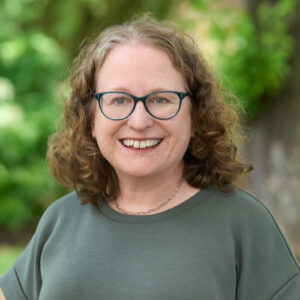 Pam Wasserman, Senior Vice President for Education, is the longest-serving employee of Population Connection by several years. She joined the professional staff with a passion for reproductive rights and environmental preservation in 1988, when the organization was still called Zero Population Growth, or ZPG (and when the world population was only 5 billion!). She came here soon after completing a fellowship at the Population Institute, which she did after earning a degree in American Civilization with a focus on American Education from Brown University.
Pam has seen talented colleagues come and go, has worked with dozens of dedicated board members, and has observed Americans’ awareness of and attitude toward population challenges ebb and flow.
It’s hard to say where the Population Education program would be without Pam’s steadfast leadership over the past few decades. She and her staff have improved and expanded the curriculum and have ensured its continued relevance in a rapidly changing world. The result is a one-of-a-kind program used by about 50,000 teachers to reach 3 million K–12 students each year.
How has the PopEd model changed since the early days of the program? Is there any aspect of it that has remained the same or similar?
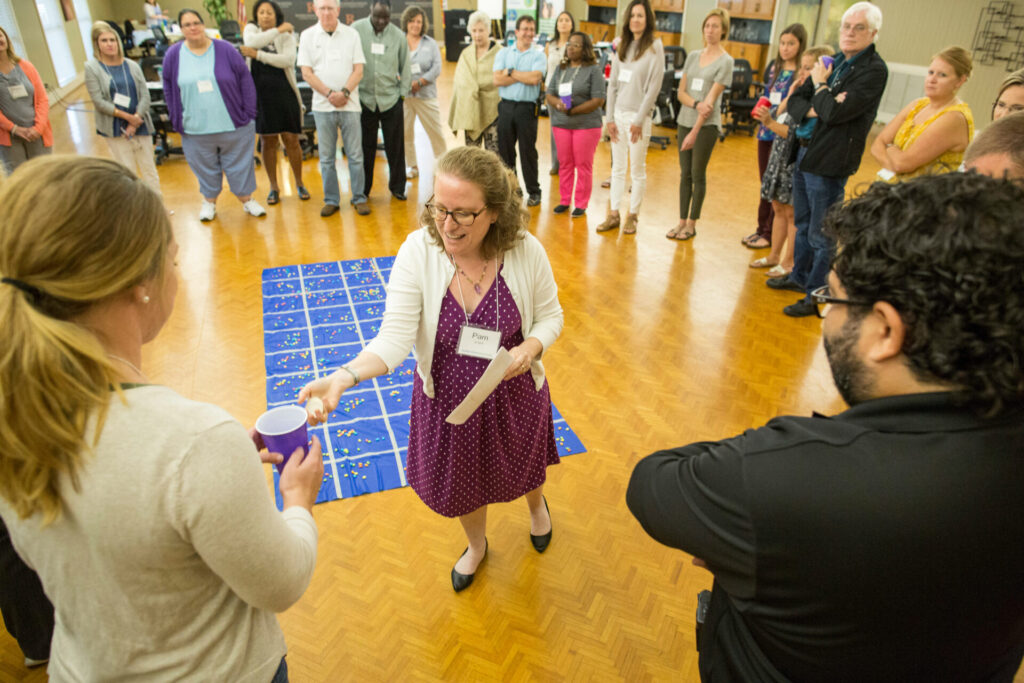
There are many aspects of the early model that are the same. Workshops are still built around hands-on activities — games, group simulations, demonstrations, and problem-solving activities — that are designed to be memorable and to motivate students to be responsible global citizens. At least 15 of the earliest activities are still in use (and have been updated as needed). That’s because the basic concepts of population dynamics and the interdependence of people and the environment are still relevant.
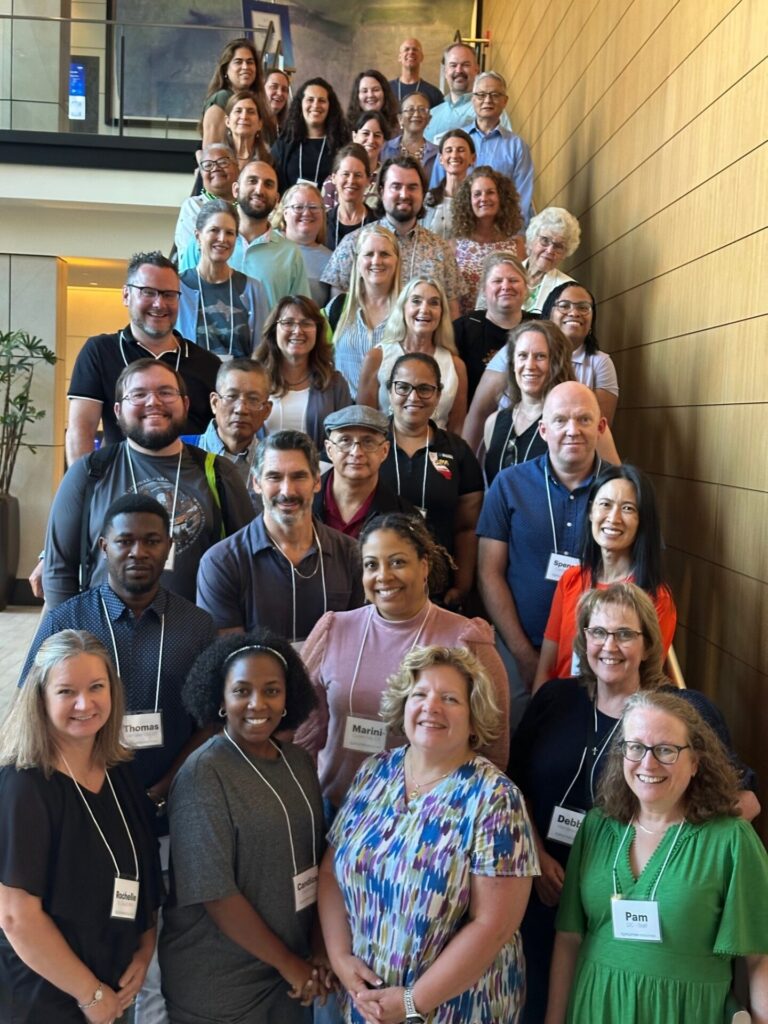
From the time we started our Population Education Trainers Network (PETNet) nearly 40 years ago, volunteers have been an important way we expand our outreach to more current and future teachers. Over half of our workshops each year are for pre-service teachers (college students who are getting certified to teach). That’s been a target audience for PopEd since the 1980s.
Our workshops have evolved technologically. We’ve come a long way from the old film reels and overhead projectors. All our materials are digital, and, in addition to in-person workshops, we now facilitate many virtual workshops. This started of necessity during the pandemic, but is now an integral part of how we meet teachers and student teachers where they are.
Part of the program’s growth has been driven by teachers. They’ve asked for materials adapted for specific student populations such as English language learners and gifted students, which we’ve eagerly developed. We also align our materials to changing curriculum standards in all 50 states and 10 Canadian provinces, to make it easier for teachers to include PopEd in their course plans.
Have the evolving demographic and environmental challenges and successes of the past half-century affected the content or framing of the teaching materials?
Absolutely. One of the earliest activities, Food for Thought, gets updated every two to three years as the data changes around global demographics, energy use, and gender equality. It’s been heartening to see many of the trends moving in a positive direction, such as an increasing percentage of girls in school, a growing middle class, declining child mortality rates, and rising life expectancy.
Creating and analyzing population pyramids has been part of our secondary curricula for many years, and we’ve seen the shape of those pyramids change for most countries as fertility rates have fallen and populations have aged.
Fifty years ago, climate change wasn’t on most people’s radar screens, let alone in school curriculum. We began including activities on global warming in our 1990 high school materials, long before it was a standard topic for the K–12 science classroom. In more recent years, we’ve added activities on ocean health, e-waste, aquifer depletion, and megacities, and have linked our activities to the UN Sustainable Development Goals.
You mentioned some health and development indicators that have improved. What about environmental indicators — has there been improvement to any of those?
There has. Air and water quality have improved tremendously in the US and many other parts of the world. We’ve successfully tackled ozone depletion in the atmosphere and reduced emissions that cause acid rain. The use of renewable energy has soared in recent years, so those are all good news stories for us to share with teachers and students. But they also need to know that progress can only be maintained if the public presses politicians to uphold laws and international agreements.
Have any of the lessons needed to be updated because health and development indicators have gotten worse?
There was a drop in life expectancy during the pandemic. There’s also been backsliding on the childhood vaccination rate because of the interruption in health services during the pandemic and also because of misinformation making more parents hesitant to vaccinate their children.
For the most part, global health trends have been positive, but in some areas, including maternal mortality and food security, we haven’t made as large a gain as many had hoped. One of our activities compares a variety of health indicators for countries around the globe, so we’re regularly updating those numbers.
It’s remarkable that the US once had an Office of Environmental Education, which gave PopEd its founding grant, and that educators across the country are now facing attempts by some in power to censor lessons about climate change and other environmental crises. How has this changing educational landscape affected PopEd, if at all?
It’s also remarkable, by today’s standards, that environmental education had broad, bipartisan support back in the 1970s. By the mid-1990s, a right-wing anti-environmentalism movement emerged, claiming that school children were being brainwashed by “environmental extremists.” This was a precursor to today’s anti-science disinformation.
While climate science has become part of most states’ adopted science education standards over the past 10–15 years, politicians have started censoring textbooks and lesson plans. Last year, Florida outright banned textbooks that mentioned climate change. So, our volunteer trainers around the country advise us on what they can and can’t include in the PopEd workshops they present.
Fortunately, there are bright spots. Two popular Advanced Placement (AP) courses, Environmental Science and Human Geography, are offered in many high schools, and both courses include entire units on human population dynamics and connections to the environment.
How do these challenges compare to what you see happening in education in Canada, where PopEd also works?
The provincial curriculum in Canada tends to be more globally focused, and geography education is emphasized more by our northern neighbors. That provides an opening for including PopEd resources. There’s also more uniformity in the curriculum within and between provinces, so not as much of a patchwork as you find with what is taught in US schools.
Why hasn’t PopEd ever gotten involved in sex education? Is it just because the field was already full, or was it more of a conscious decision to focus on population and environmental studies over reproductive health?
From the start, the PopEd program defined itself as being separate from sex education. At the time, quality materials and teacher training were available from other organizations, such as Planned Parenthood, that specialized in teen reproductive health.
Sex education is primarily included in middle and high school health classes. PopEd curricula was developed to be integrated into social studies and science instruction. It was conceived (no pun intended) to make the connections between population trends, natural resource use, food security, ecosystem health, and human wellbeing around the globe. We also present many workshops for K–5 teachers who teach all subjects, so we make sure our activities also bring in math and language arts.
Is there any topic the PopEd program is newly covering or plans to begin covering in the near future?
We’re trying to keep up with the very rapid changes in artificial intelligence (AI), especially in terms of how teachers find us in their digital searches for curriculum. In updating our high school curriculum this year, we included a new case study reading on two very low-fertility countries (South Korea and Mauritius) so students can explore the different conditions that contributed to those trends. Zoonotic diseases are part of a secondary activity on how infectious diseases spread. So, yes, we’re always trying to stay current. When choosing the topics for our student video contest each year, we also ask teachers and students for the issues on their minds.
What prompted the introduction of the World of 7 Billion (now the World of 8 Billion) student video contest in 2010? Why did you want to work directly with students?
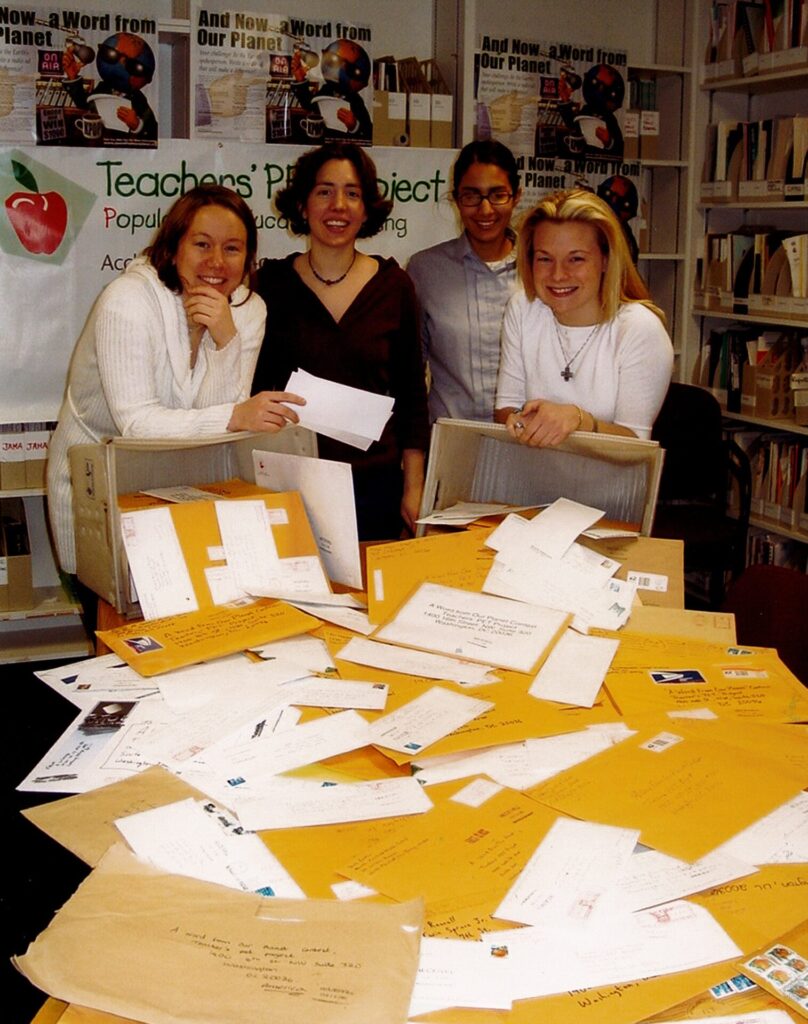
Student contests have been part of PopEd’s program for several decades. Before the video contest, we challenged students with writing and art projects. In 1998, we hosted the Pop TV Contest, in which students had to write a plot treatment for a current TV show that included content on population. I remember winning entries for Seinfeld and The Simpsons. In 2002, we received close to 5,000 entries for a radio PSA contest titled “And Now … a Word From Our Planet.”
When we were approaching the 7 billion milestone, we decided to change up the media to video since so many students had access to smartphones and small camcorders. It was meant to be a one-time event. When we didn’t host it the following year, we heard from lots of teachers asking us to bring it back. It’s been a part of our program ever since. We’ve had 55,000 students from all 50 states and 105 countries participate. We launched our 15th video contest this fall!
If you could lift one barrier or change one policy or trend that affects PopEd, what would it be?
The biggest barrier to expanding our outreach to more teachers is the decline of young people entering the teaching profession. Over the past 15 years, the number of students enrolled in teacher preparation programs has dropped by more than a third. It’s a high-stress job, and teachers aren’t paid what they’re worth. More censorship and less teacher autonomy have turned many schools into stifling workplaces. Over half of our PopEd workshops are for pre-service teachers, but those university class sizes have been shrinking. If policymakers care about building an educated electorate and workforce, they’d do more to elevate the teaching profession in the US.
Lastly, do you think there will still be a place in K–12 education for PopEd 50 years from now?
Everything is shifting so quickly in our world that it’s difficult to make predictions for a year from now, let alone 50 years!
PopEd stays viable as long as we keep it current. According to the UN medium projection, in 50 years, the global population will be nearing its peak. But there will always be a need for education on the delicate balance of people and the environment, and on the benefits of raising living standards and providing equal opportunities everywhere.
Pam Wasserman: pwasserman@populationeducation.org
Marian Starkey: marian@popconnect.org