Global Partners, December 2025
Written by Marian Starkey | Published: December 8, 2025
Wuqu’ Kawoq (Maya Health Alliance)
This unique organization, headquartered in Tecpán, Chimaltenango, in the Central Highlands of Guatemala, was co-founded by American cultural anthropologist Anne Kraemer. Anne fell in love with Guatemala when she visited in 2003 and then returned as a Fulbright Scholar in 2007 to perform an ethnography on the effects of NGOs on rural Guatemalan communities. She and leaders in the Maya Kaqchikel town of Santiago, Sacatepéquez, established Wuqu’ Kawoq (also known as Maya Health Alliance) that year, at the request of the community, and Anne has served as Executive Director/CEO since 2009. The following article draws from presentations Anne gave during Population Connection virtual events in 2023 and 2025.
Reaching the country’s most marginalized people
Although recent data isn’t available, family sizes in Indigenous communities are observably larger than in Ladino (the Guatemalan term for Spanish-speaking people of mixed Indigenous and European ancestry) communities. Higher fertility — in a country that already has one of the highest fertility rates in Latin American — is one reason that Mayan women are three times as likely as non-Indigenous women in Guatemala to die from preventable pregnancy-related causes. Each pregnancy and delivery presents its own risks, and when pregnancies occur too early or without adequate spacing in between, those risks multiply.
Another reason for poor maternal health outcomes among Indigenous women is that most providers in Guatemala speak only Spanish, leaving them and their patients without a fluent way to communicate with one another. Many Indigenous women report that they would rather die at home than be treated in a hospital where they might be ignored, misunderstood, or mistreated.
Wuqu’ Kawoq therefore places great emphasis on employing people who share the language and culture of their patients. Nearly all (95%) of the 130-person staff are Guatemalan, and 80% are Indigenous Maya. Over 30 nurses and community health workers deliver linguistically and culturally appropriate care in nine Guatemalan departments, in seven languages, and only at the invitation of the community. Nurses are either from the very community they’re serving or from another one nearby.
Recognizing that some patients will inevitably require advanced medical care during their pregnancies, Wuqu’ Kawoq midwives co-designed an app that monitors and detects problems and then helps Indigenous providers translate and coordinate care for women who need to go to a hospital. This makes a stressful situation a little less traumatic for patients and their families and providers.
Reducing physical and cultural barriers to health care
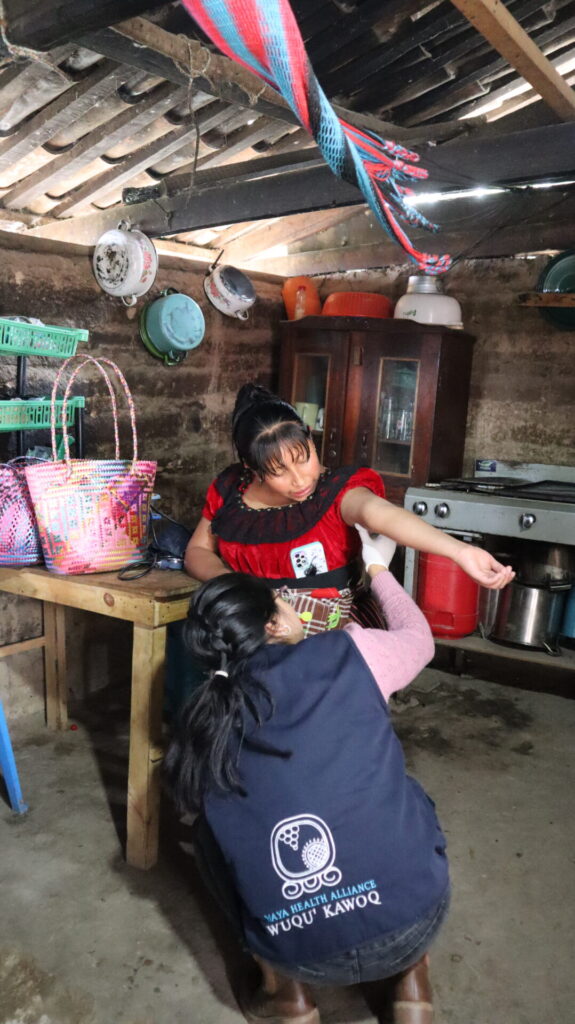
Wuqu’ Kawoq is always looking for ways to reach patients where they’re most comfortable. One way they achieve this is through home-based health education classes that teach attendees about sexual and reproductive health and health throughout the life cycle. After they have taken part in these classes, participants are offered the full range of contraceptive methods — they can have a long-acting method inserted or implanted or a short-acting method injected or given in the form of pills or condoms. This home-based approach reduces barriers related to distance, cost, and patient-provider trust. Those who request a permanent method (tubal ligation or vasectomy) are referred to WINGS Guatemala, another Population Connection Global Partner.
Machismo is an important cultural barrier that women often struggle to overcome when they are interested in beginning to use a contraceptive method. Many women are worried about their husbands’ reaction to them wanting to delay or prevent pregnancy. Knowing this, Wuqu’ Kawoq employs men who go out into communities and speak directly with other men about family planning, reproductive health, and healthy family relationships. Getting men on board with family planning increases contraceptive uptake and leads to longer and more consistent use of methods.
A worthy investment
The majority of funding for Wuqu’ Kawoq comes from individuals and foundations in the US, Canada, and Europe. All services are provided completely free to patients. In 2024, over 10,000 patients received primary care and services related to women’s health, maternal health, child malnutrition, diabetes, and complex care at nearly 36,000 care visits. Close to 2,000 women received testing for cervical cancer, the second deadliest cancer among women in Guatemala, and over 3,900 women received family planning methods.
Marian Starkey: marian@popconnect.org