Activities for America’s 250th Anniversary
Written by Pamela Wasserman, Senior Vice President for Education | Published: March 9, 2026
This year’s Independence Day is the 250th anniversary of our nation’s founding. To mark this Semiquincentennial, PopEd is promoting lesson plans to help high school students explore US demographic and environmental history, and the social and economic trends that have influenced demographic shifts.
We are updating 330 Million in the USA, a curriculum developed following the 2020 Census for use in US history, civics/government, geography, economics, and environmental studies classes. The free, downloadable curriculum includes 14 classroom activities, six readings, and a set of infographics depicting historical trends in family size, immigration, wealth distribution, and more.
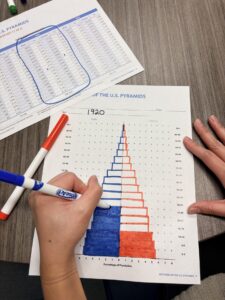
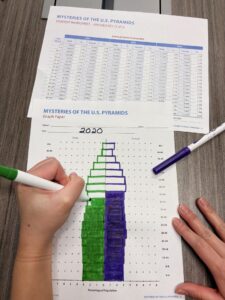
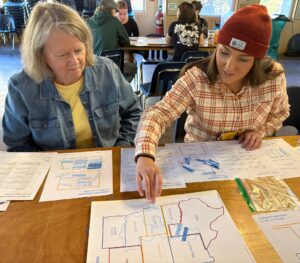
Several of the lessons focus on changing population dynamics since the first Census in 1790. These include “Mysteries of the US Pyramids,” where students create and analyze population age and sex distribution graphs for different points in history, and “Connecting the Dots,” in which they make population density maps that depict changing settlement and migration patterns.
Using historical Census data, students track fertility trends in a single community through the decades in “Family Counts.” Historical documents are also used in “American HerStory,” helping students consider changes in women’s participation in the labor force and government.
US government is also the subject of “The People’s House,” where student teams debate the pros and cons of expanding the size of the US House of Representatives. Since 1929, the House has been capped at 435 members, resulting in ever larger congressional districts as the country’s population has nearly tripled over the past century. Each debate team crafts its arguments after reading primary and secondary sources on the subject (e.g. The Federalist Papers and newspaper commentary). This lesson also includes an exercise in gerrymandering, a process made easier with fewer representatives.
Other activities focus on US environmental history. In “Almighty Aquifers,” students represent states that draw water from the Ogallala, or High Plains, Aquifer in the eight states from Wyoming and South Dakota in the north to Texas and New Mexico in the south. In a board game, they experience the aquifer’s changing water levels as the population and water demands grow through the decades.
For “Our Shared Environmental History,” students research one of 36 environmental events in the US over the past century and then add their findings to a class timeline (either along the classroom wall or digitally). Timeline markers include catastrophic events (from the Dust Bowl to the Flint, Michigan, water crisis), citizen action (like the first Earth Day), and groundbreaking environmental legislation for clean air, water, and wildlife protection.
Economics is another theme in the lesson set. In “Making It in America,” students examine mathematical models on wealth distribution from the 1960s to the present and assess the public’s changing perceptions of “The American Dream.”
Background readings focus on specific themes in US history — immigration, work life, transportation systems, food and agriculture, schooling, and environmental movements. One of the readings, “America Pairs Up,” covers the history of love and marriage in the US, including contraception, sex education, and family size.
These US-focused lessons and readings aren’t just a look back at the past. They also give students an opportunity to project where the country might be headed. “Looking to the Future” invites students to predict what life in the US will be like 50 years from now — when we approach the US Tercentenary!
In addition to this curriculum set, the PopEd website contains dozens of blog posts on national events and population trends throughout US history, such as the Great Migration, industrialization, and changing energy sources. All the resources are online at populationeducation.org.
pwasserman@populationeducation.org