
Empowering Educators for Half a Century
Written by Lindsey Bailey, Education Network Director | Published: December 8, 2025

The Volunteers Behind PopEd’s Success
The Population Education (PopEd) program would not be what it is today without the hard work of our trainers. Since the formation of the Population Education Trainers Network (PETNet) in 1987, volunteers have been facilitating PopEd workshops with educators in their local communities, training thousands of teachers on how to cover population issues. We are forever grateful for their commitment that allows our program to thrive.
As we celebrate 50 years, we’re looking back at how the network has changed over time, reflecting with some of our longest serving members, and shining a light on the integral role our volunteers play in the success of the PopEd program.
A brief history of the PETNet
We began recruiting educators to become PopEd trainers in the spring of 1987. That first year, just a handful of trainers presented nine workshops. Since then, the PETNet has had a total of over 1,300 volunteer trainers. There are currently nearly 700 educators in the network, representing 46 US states, two US territories, the District of Columbia, and five Canadian provinces.
We owe much of the growth of our network to the passion of current trainers, who recruit others. Upon joining the network, trainers are invited to attend a train-the-trainer Leadership Institute, where they learn to lead workshops in their local areas. Since 1990, we’ve hosted 55 Leadership Institutes, adding hundreds of new volunteers to our network.
To date, our volunteers have facilitated 9,789 workshops, an average of 258 per year, and over half of all PopEd workshops ever led (16,626), enormously contributing to our program reach. Thanks in large part to them, we have trained 330,000 teachers since 1985!
Training educators to teach PopEd
During workshops, trainers lead PopEd lessons as if they were in a K–12 classroom, with teachers participating as if they were students. Trainers showcase best practice pedagogy, model questioning techniques, and ensure that PopEd lessons are relevant to their audience by connecting to state standards and local issues. The feedback we receive about our trainers after workshops is consistently positive.
Each workshop requires a commitment of both time and expertise. In a measure of just how much our volunteers give, we calculate over $5 million of in-kind contributions of time over the past 20 years, an average of roughly $240,000 annually.
Volunteers also support our program in other ways. Trainers help to write and review new lesson plans, serve as judges for our annual World of 8 Billion student video contest, co-present webinars with our staff, and advise on the ever-changing education landscape.
“This has been one of the most engaging and fun workshops that I have been to.”
Reflections from four long-serving volunteer trainers
We are fortunate to have many volunteers whose dedication to PopEd has been unwavering over the years. Through shifts in environmental policy, evolving curriculum standards and testing, and the more recent politicization of science-backed topics like climate change, many in our network have continually brought PopEd into their communities in effective ways.
I had the pleasure of talking with some of these remarkable educators to get a better understanding of what drives them to stay involved, how their workshop presenting has changed over the years, and what they love most about PopEd.
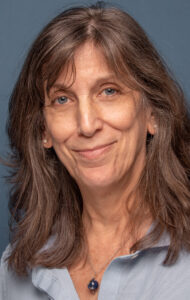 Susan Schleith, Program Director of K12 Education, Florida Solar Energy Center
Since joining us in 1995, Susan has trained 680 educators via 30 presentations. Through her role at the Florida Solar Energy Center, Susan links population growth to growing global energy demand and our changing climate. She has used PopEd’s “dot video” in many of the Center’s educational materials over the years to make a powerful visual link between growing human numbers and the need for more sustainable energy sources. “To me, energy is everything. Everyone needs energy to survive, and the more people there are on the planet, the more energy we use. That’s why we have climate issues, and we’ve got to do something.”
A favorite lesson of Susan’s is Food for Thought, which takes a critical look at energy inequities around the world. She has also enjoyed sharing one of our newer activities, People and Climate Change: The Data Is In, where students analyze data on CO2 emissions, warming global temperatures, land ice melt, and sea level rise. On teaching topics like climate change over the years, especially in her home state of Florida, Susan said, “The pendulum swings, and you learn to still convey the facts, just using different words.”
Asked why she’s been a volunteer for so long, Susan expressed her deep belief in the PopEd mission, adding, “PopEd has created engaging, relevant activities that have impact. I appreciate having access to such good, solid material that is science-based, and that’s why I do it.”
“The facilitator was energetic and engaging throughout the whole workshop. It was obvious that she is passionate about the topic.”
–Pre-service student at University of Central Florida
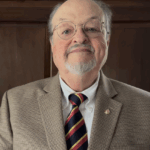 Michael Bentley, Retired Associate Professor of Science and Environmental Education, University of Tennessee, Knoxville
Michael has always had a passion for population studies. He taught a population biology course to high school students for many years, and read Paul Ehrlich’s The Population Bomb as soon as it came out. He joined us in 2003, and has trained over 1,200 teachers and counting.
Michael’s favorite ‘hook’ in workshops is to share that since his birth in 1946, the global population has more than tripled. He also likes to introduce the concept of carrying capacity using the lesson The Stork and the Grim Reaper, which uses water to show the relationship between birth and death rates.
I asked Michael if he’s noticed any changes over time in how educators react to PopEd lessons. “I have always found teachers very receptive to the activities because they are not complicated and they use readily available materials,” he said. “They are engaging, and the lesson plans are so clear about what the teachers need to do.”
Michael’s passion for population and the environment is one of the reasons he’s stayed engaged with PopEd for over 20 years. He monitors population and climate statistics around the world and noted that it’s important to focus on climate mitigation and resilience: “We’ve already crossed so many boundaries, so the real effort has to be in mitigation and resilience. We have to get the message across to people who will be teaching.”
“Loved the commitment of the presenter. Easy to understand and do. I will recommend. Made the numbers talk.”
–Participant at Virginia Science Teachers Association conference
 Deb Gallagher, Retired Professor of Math and Science Education, Bowling Green State University, Ohio
Deb first learned about the PopEd program when she attended a workshop at Bowling Green State University in the late ’90s. Since attending a PopEd Leadership Institute in 2002, she’s led 58 workshops and reached over 1,100 educators.
Deb’s passion is middle-childhood education, especially in math and science. One of her favorite PopEd lessons is Measuring a Million, which teaches students about the scale of millions and billions to help them understand just how big our global population is. She also gravitates to lessons like Power of the Pyramids that use real-world data to explore global issues.
She shared that teachers have always loved the lessons, but that there is now more rigidity in what they must cover in classrooms. When presenting today, she’s careful to emphasize how PopEd lessons “are not just fun, they really do align and are a great way to teach [state education] standards.”
When asked why she’s volunteered for so long, Deb responded that the data is always current and reputable, and she appreciates the support of PopEd staff in planning workshops. But ultimately, she said, seeing the enthusiasm of the teachers she trains is the most rewarding, and she loves to hear their stories later on about how they’ve used PopEd lessons.
“Great energy and passion for her material.”
–Participant at Ohio Middle Level conference
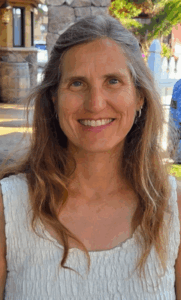 Helen de la Maza, Science Specialist with the Irvine Unified School District; Lecturer at University of California, Irvine
Helen attended a Leadership Institute in Long Beach in 2001 and has been a go-to trainer in southern California ever since, reaching over 1,200 educators through 66 workshops.
When asked about her favorite lessons to present, Helen said, “Any that focus on sustainability and awareness raising; the idea that we, especially here in the United States, have access to resources and we can make choices about how we use and interact with those resources.” She shared that one of her favorite lessons is For the Common Good, where students compete for shared resources in a commons, noting that “it really shows what people are motivated by and how people think.” She also loves Who Polluted the Potomac, and has adapted the interactive story to reflect pollution of the San Diego creek over time.
When talking about why she’s stayed committed to the volunteer network, she pointed to the steady leadership of Pam Wasserman, Senior Vice President for Education, and the way support from our team allows her to feel “backed” and “empowered.” She also appreciates how PopEd has adapted to increased technology use in classrooms, mentioning her love of our WorldPopulationHistory.org microsite and the set of digital tools that now accompany PopEd activities.
“Helen was very detailed, perfectly paced, and easy to understand. Great presentation.”
–Participant at CA STEAM Symposium
We know that the sentiments of these four longtime volunteers are echoed among the hundreds of trainers in our network. If we could, we would feature every single one of our PETNet trainers for the amazing work they do with teachers on the ground and for tirelessly lending their expertise to build a stronger PopEd program and a more just and sustainable world.
Lindsey Bailey: lbailey@populationeducation.org