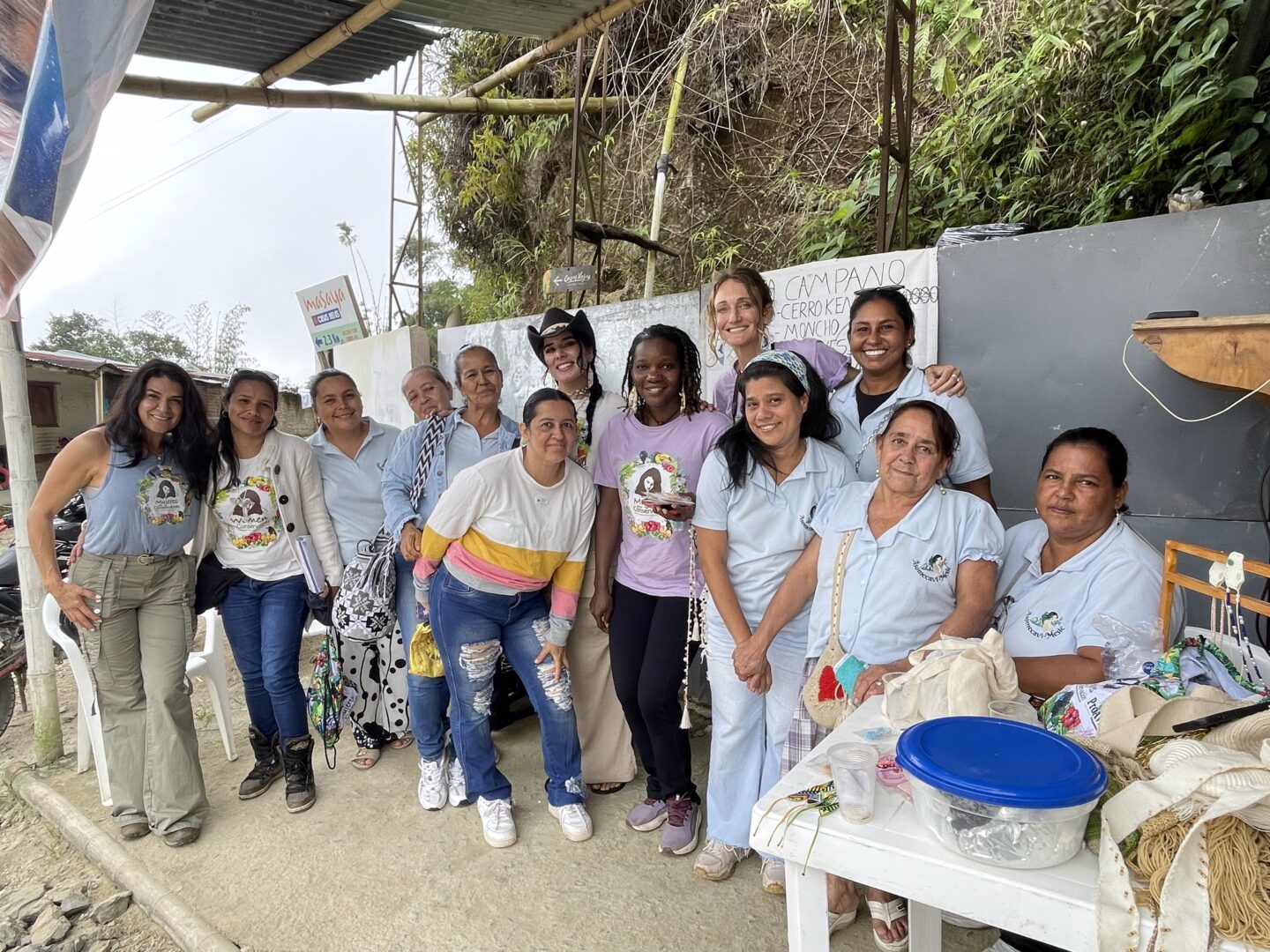
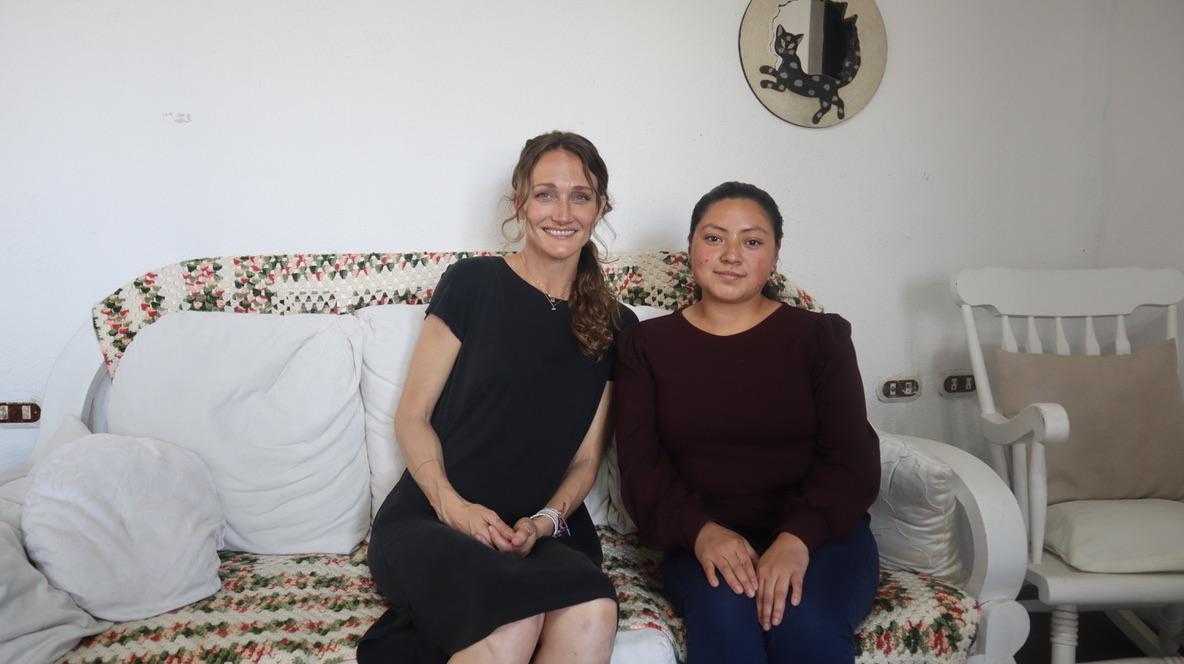
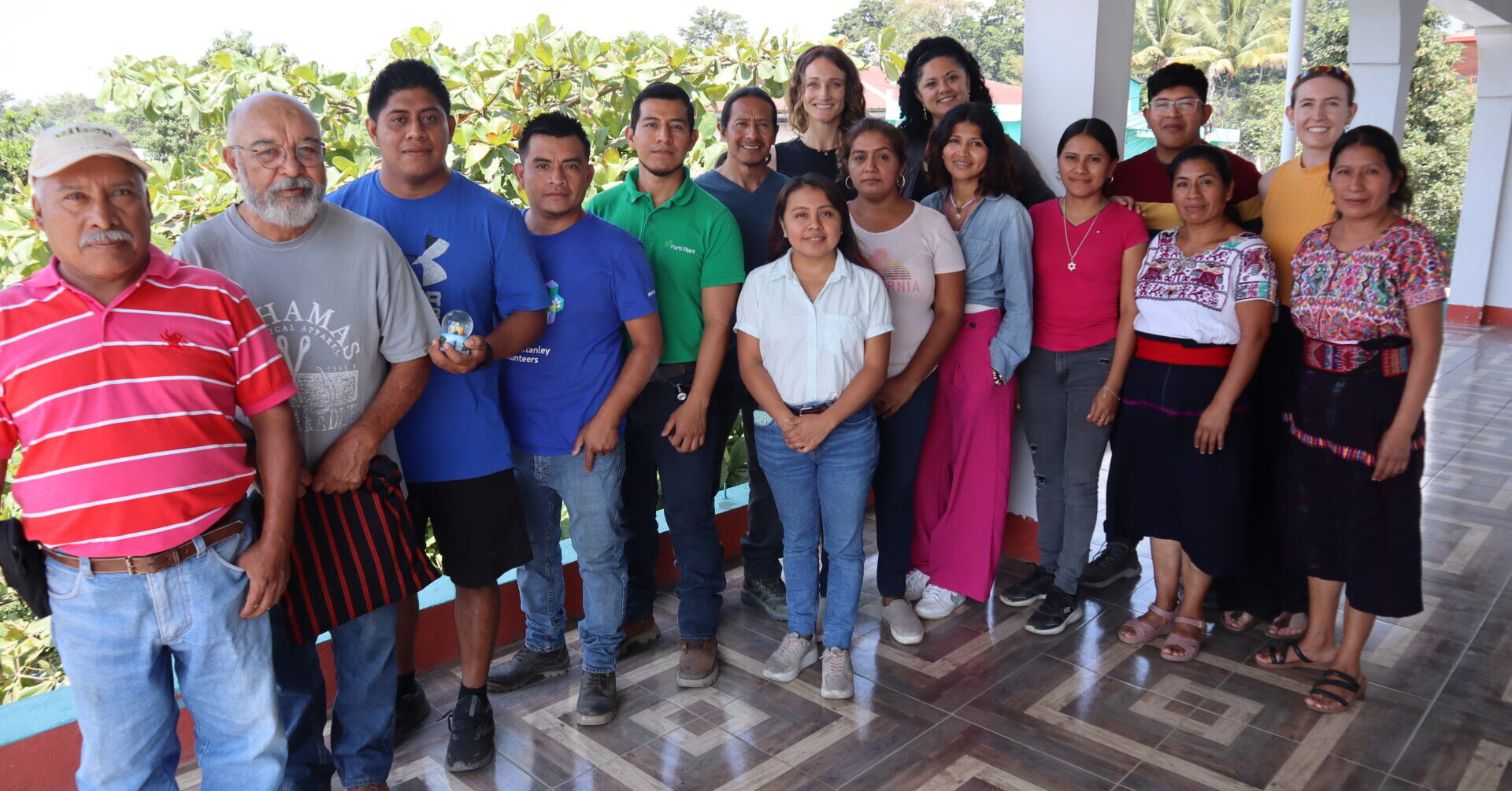
Hannah, Florence, and the Women for Conservation team with the women's collective in Campano.
A women-led movement for a better future: Women for Conservation field report
Written by Hannah Evans |
Published: December 5, 2025
Population Connection Senior Analyst Hannah Evans reports on a site visit to El Dorado Nature Reserve in the Sierra Nevada with Women for Conservation, our Global Partner based in Colombia.
Meeting Sara and Isabella
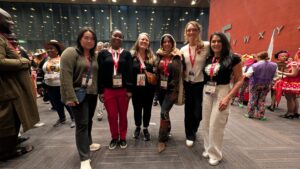
The Population Connection delegation with Sara (far right) and Isabella (third from right) at ICFP in Bogotá.
When we first met the Women for Conservation team at the International Conference on Family Planning (ICFP) in Bogotá, it felt less like an introduction and more like a reunion. They approached our booth with huge smiles and palpable enthusiasm—radiating the warmth, charisma, and easy openness that I’ve always loved in Latin American culture.
Sara Inés Lara, an engineer-turned-environmental activist, leads Women for Conservation with her daughter, Isabella—a singer, artist, and conservationist who transforms her deeply spiritual connection to nature into music and beautiful murals found across Colombia. Together with a dedicated staff of women and men, they are among the first to integrate women’s empowerment and conservation in a way that drives sustainable development in Colombia’s most biodiverse, underserved regions.
“The connection is crucial,” Sara told me during an interview. “It can’t be denied. When you listen to the people from the community, they will give you the answer—that there is an urgent need and it needs to be addressed. This is why I started Women for Conservation: the purpose is to put women at the forefront.”
Founded in 2019, Women for Conservation partners with communities in biodiversity hotspots to empower women as environmental leaders and stewards of sustainable livelihoods. Since 2020, the organization has conducted 68 workshops and reached close to 3,000 participants—mostly women and children—through training in nature guiding, conservation, sustainable crafts, children’s environmental education, and reproductive health.
The Road to El Dorado Nature Reserve
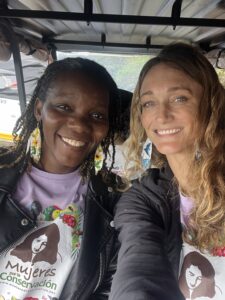
Florence and Hannah at El Dorado Nature Reserve.
After ICFP ended, my colleague Florence and I flew to Santa Marta—a coastal city backed by the formidable Sierra Nevada mountains—where Sara and Isabella met us the next morning. “This land is sacred,” Isabella told us as we began the drive to the high-altitude El Dorado Nature Reserve (9,268’ at its highest point), which Women for Conservation helped bring to life alongside ProAves, a leading Colombian bird conservation organization.
“The Indigenous communities that have historically occupied this land, the Kogi people, believe that the Sierra Nevada is the heart of the planet,” she told us. “And that the state of the world is a reflection of the vitality of this region.”
As we climbed higher into the mountains, Sara pointed out the dramatic environmental changes they’ve witnessed: disappearing cloud forests, invasive species, and rising temperatures. “The top of these mountains was once dense cloud forest,” she said. “Temperatures here have risen at least 20 degrees over the past 15 years.”
Before reaching the reserve, we stopped at the home of Sofia, a woman who has worked with Women for Conservation for several years, producing artisanal crafts to support her family. She greeted Sara and Isabella with the warmth of a close relative. Sofia shared with Florence and me how meaningful their support has been. “They’ve helped me in the moments when I’ve needed it the most,” she told us.
“We are like family,” Sara told me as we continued the journey upward—now on unpaved, rocky roads that forced us to move very slowly along the mountainside.
El Dorado
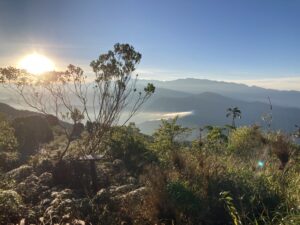
El Dorado reserve.
Arriving at El Dorado felt like stepping into another world. Hummingbirds darted from flower to flower, their wings whipping and humming through the air. Mist rolled through the trees. We were surrounded by the most pristine nature imaginable. I could hardly believe my eyes. Everywhere, life thrived!
Sara smiled proudly as she welcomed us to the reserve. “I’m so happy to share with you the work of many, many years.”
Over the next few days, we learned how Women for Conservation began linking conservation with reproductive health over the years.
“This was the first place we realized how little access women had to family planning,” Sara said. “It didn’t exist here. That’s why we made reproductive health one of our pillars. We’ve now worked with hundreds of women—many of the girls we met 20 years ago are now adults with families, and they’re still involved in the programs. That’s why we’re expanding.”
Women for Conservation’s three pillars guide their work: nature and conservation; family planning and reproductive health; and sustainable economic opportunities. Their model has transformed not only individual lives, but entire communities—shifting norms around education, family planning, and women’s roles. In a conversation about the cultural challenges women face in Colombia, Isabella spoke to us candidly about the realities many girls and women face. “Here, the culture can be horrible towards women,” she said. “Men refuse to use condoms—they think it’s a sign of ‘strength’ to get many women pregnant. We have to be so careful.”
“We are seeing more women go to college now,” Sara explained to us in a conversation about the organization’s impact. “Before, it was more common for girls to become pregnant before finishing high school.” Kelly, their Programs Specialist from El Dorado, provided further context by speaking into the organization’s broader mission: “We want women to learn about their environments, but also to create jobs for themselves. Many women receive training to become nature guides or bird monitors. We help communities have the tools to become who they want to be.”
Women’s Collective in Campano
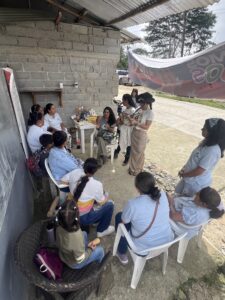
The women’s collective in Campano.
A few days later, we began our descent down the mountain and back towards Santa Marta. We stopped in the small town of Campano, where about a dozen women gathered in a small space on the side of the road to greet us. Their collective—created and supported by Women for Conservation—receives training in environmental stewardship, sustainable artisanal work, and entrepreneurship.
“When women have an income, the dynamic in the household changes,” Sara told me. “Women have more power and a greater say—this is a huge shift.”
We gathered together to look through the items the women had brought to sell. The women proudly displayed their goods—clothing, beaded bracelets and jewelry, baskets, local foods. Their biggest challenge, Sara explained, is finding a bigger and more permanent place to sell their products. The group brainstormed solutions, energized by the idea of expanding their reach.
At the end of the meeting, the women took turns sharing about the impact that this collective has made in their lives. Many expressed gratitude for the opportunity and the increased freedom and confidence that it has helped create for them. “The support you give us is an immense motivation,” one woman shared. “I don’t have words to express how much your help means to us. Thank you.”
Profamilia Clinic in Santa Marta
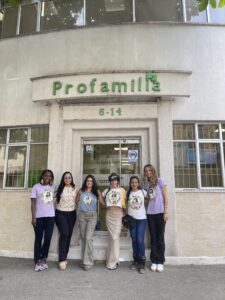
Florence, Hannah, and the Women for Conservation team at the ProFamilia clinic in Santa Marta.
Back in Santa Marta, we visited the Profamilia clinic that Women for Conservation partners with to bring sexual and reproductive health services to communities in and around the Santa Marta region. The staff spoke openly about their work delivering family planning clinics every two to three months, and about the challenges that remain.
“There are still many taboos,” one provider said. “Right now, all the responsibility is put on women. That has to change. Men also need education.”
Isabella reflected on the transformation they’ve seen over time:
“Poverty and machismo have made it incredibly hard for women here to access family planning. We were the first to go into these communities and offer services. To see the changes now… it’s incredible.”
In 2025 alone, Women for Conservation and Profamilia facilitated 66 implants, 49 tubal ligations, 92 vasectomies, and 31 health check-ups. Together, they have consulted 2,580 people about family planning—most of whom were receiving the services for the first time.
Sara added that Indigenous couples—who historically faced strict cultural prohibitions around contraception—are now coming to the clinic together. Husbands have begun accompanying their wives to receive services. “This is a big deal,” she said. “This was unheard of before.”
Women’s Group in Sinasana – Taganga, Santa Marta
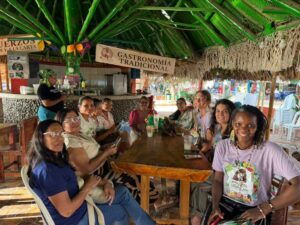
Sinasana women’s group.
Later that day, we went to a local seaside restaurant in the community of Sinasana, just outside of Taganga, where we met with a vibrant group of women entrepreneurs. The group eagerly gathered together to brainstorm new products to create and sell, and came up with the idea of organizing a sustainable fashion show. One woman proposed making clothing from recycled plastic bottles. This led to a lively conversation about the dangers of microplastics.
“Microplastics are harmful to our health, and they’re everywhere,” Sara explained. “They’ve even been found in breastmilk.” It was wonderful to witness the conversations the women were having about sustainability—dissecting what truly makes a product “sustainable” and how to consume more consciously. “Microplastics are something we haven’t heard about before, so we’re learning,” Kelly, the Programs Specialist, told Sara during their exchange. The women were engaged, excited, and eager to learn more. For many of them, this collective is the first space where their creativity and ambitions are encouraged—where they can dream freely.
Rana Chiva
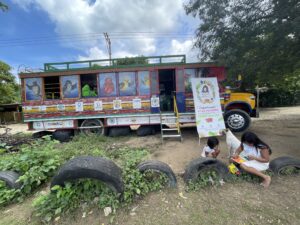
Rana Chiva.
Our final stop was to a community called Dibulla, in the heart of Palomino, where we visited Women for Conservation’s Rana Chiva (the “Frog Bus”)—a brightly-painted school bus-turned-mobile classroom designed to bring conservation education into remote rural communities. This day, the bus was stationed in front of Dibulla’s community park, where Katrin, a Programs Specialist at Women for Conservation, was hosting an environmental education workshop for Indigenous youth.
“We have traveled across Colombia for about three and a half years now,” Katrin explained during an interview about this initiative. “We came here today to work with the Kogis, which are an Indigenous group from the mountains of Colombia. They walked two to three hours to come here today.” Katrin went on to talk about how meaningful this work is. “It’s so amazing to see the look on their faces,” she told us happily. “They’ve never seen something like the Rana Chiva. They live in the mountains, far removed from something like this.”
After our conversation, we all boarded the Rana Chiva, its interior covered in beautiful paintings of tropical plants and animals that Isabella had created. We listened to a presentation led by Katrin about biodiversity and conservation.
“I love to tell people that, yes, we should all be proud to be Colombian. But Colombia also represents biodiversity. We have to be proud to protect this land as well.”
After Katrin’s presentation, Isabella sang a few of her songs—each one filled with lyrics celebrating the magic and beauty of nature. The children were completely transfixed, following along line by line, deeply engaged and excited by this way of learning. It was beautiful to see how art, music, and storytelling blended seamlessly with the lesson, helping the children connect with their environment in ways that nurture a genuine desire for conservation.
A movement, a community, and a family
Throughout this journey—from Bogotá’s conference halls to the cloud forests of El Dorado to the communities of Santa Marta—one thing became resoundingly clear: Women for Conservation is not just an organization. It is a movement, a community, and a family. It is women empowering women, stewarding the land, and rewriting their futures in places where opportunities have long been limited.
As Kelly told me passionately as we were leaving El Dorado,
“What do I love most about this work? It’s the chance to help—women, youth, communities, the planet. To give people the tools to become who they want to be.”
Women for Conservation is proof of what happens when you trust women, invest in them, and let them lead—not just for themselves, but for the future of our shared planet.
Visiting our Global Partners in Guatemala: Manos Abiertas Field Report
My journey to Guatemala In March, I set out on a journey to visit Population Connection’s amazing Global Partners in Guatemala. The experience was both inspirational and transformative, and a…
Visiting our Global Partners in Guatemala: Seeds for a Future Field Report
My journey to Guatemala In March, I set out on a journey to visit Population Connection’s amazing Global Partners in Guatemala. The experience was both inspirational and transformative, and a…