Forests are some of the most important ecosystems on Earth, playing a vital role in sustaining millions of species, including humans. Unfortunately, forests are also incredibly threatened by human activity. On International Day of Forests, here are four important facts about forests you may not be familiar with.
1) What proportion of the Earth’s land is covered by forests?
Earth had approximately 4 billion hectares of tree cover in 2023, which equates to roughly 30% of all land coverage, and 38% of land that is not barren or covered in ice. Not all of these trees are natural forest, however — planted trees such as those in orchards and in palm oil, coffee, and timber plantations make up around 11% of global tree cover.
The most ecologically valuable type of woodland is primary, or old-growth, forest that has not been damaged or degraded by human activity in recent history. Unfortunately, primary forests are being destroyed at an alarming rate.
It’s estimated that 10,000 years ago, there were 6 billion hectares of forests, covering 57% of the world’s fertile land. This means we’ve lost more than 40% of the natural forests that were present at the end of the Stone Age.
2) How many different kinds of forest are there?
There are four main forest biomes: boreal, tropical, subtropical, and temperate.
The boreal forest, also known as taiga, is found in cold northern latitudes (between 50°N and 70°N), where large parts of the soil remain frozen all year round (permafrost). The boreal forest accounts for 27% of the world’s total forest area and spans 17% of Earth’s land surface, making it the world’s largest terrestrial biome. Boreal forests have relatively low tree species diversity, comprising mainly conifers such as pine, spruce, and fir, as well as some deciduous broadleaf species (whose leaves change color and are shed in the fall) such as poplar and birch.
 Tropical forests grow in tropical climates close to the equator, between the Tropic of Capricorn (23.5°S) and the Tropic of Cancer (23.5°N). They are the warmest and most humid forests, and include several subtypes, including rainforests, cloud forests, and mangroves. Tropical forests contain evergreen broadleaf trees (which maintain their green leaves year-round) and have very high tree density, making up 45% of global forest cover and around 12% of Earth’s terrestrial surface. Tropical forests are the most species-rich biomes on Earth. Rainforests alone are home to as many as 80% of the world’s recorded species.
Subtropical forests are located between tropical and temperate zones both north and south of the equator. Unlike tropical forests, subtropical forests experience seasons with cooler temperatures. They make up 11% of global forest area and contain a mix of deciduous and evergreen trees.
Temperate forests are found in latitudes between 25° and 50° in both hemispheres. They are marked by four distinct seasons (spring, summer, fall, winter), but generally no extreme temperatures. They contain mostly deciduous broadleaf trees, as well as conifers. Around 16% of global tree cover is composed of temperate forest.
3) What services do forests provide?
One of forests’ most vital ecosystem services is their role as carbon sinks. Trees absorb carbon dioxide from the atmosphere as part of photosynthesis. Between 2001 and 2019, the world’s forests absorbed on average a net 7.6 billion metric tons of CO2 per year, which is 1.5 times more carbon than the United States’ annual emissions. Thus, forests are key to limiting climate warming from greenhouse gas emissions. Unfortunately, when forests are cleared or burn down, they become significant sources of carbon emissions. The Amazon rainforest, which has one of the highest deforestation rates, is at significant risk of passing a tipping point at which it would turn from a carbon sink to a carbon source.
Forests play an essential role in maintaining biodiversity, the variety of life on Earth. Forest ecosystems are incredibly rich and complex, with an astonishing assortment of plant, animal, and fungi species inhabiting their many layers, from soil to canopy. Forest habitats are home to 80% of known amphibian species, 75% of bird species, and 68% of mammal species.
Forests also store groundwater, help purify air and water by removing pollutants, and generate cooling humidity through evapotranspiration (release of vapor from soil and leaves), which influences cloud formation. Trees prevent soil erosion through their stabilizing root systems, and act as important flood defenses.
Countless communities and livelihoods are sustained by forests through the provision of food, timber, and fresh water. In addition, forests provide genetic resources used in medicine and research, as well as recreation opportunities and psychological and spiritual benefits.
4) What is driving deforestation and how can we save forests?
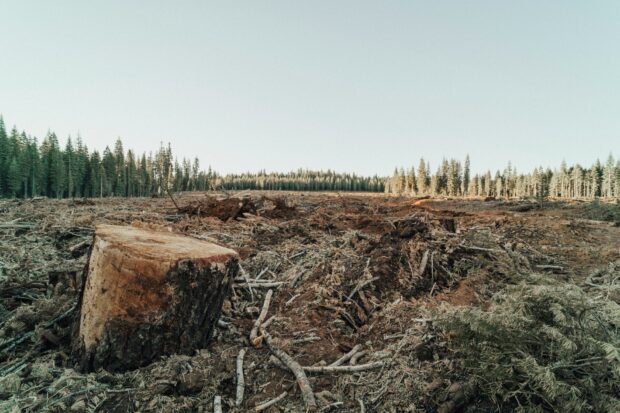
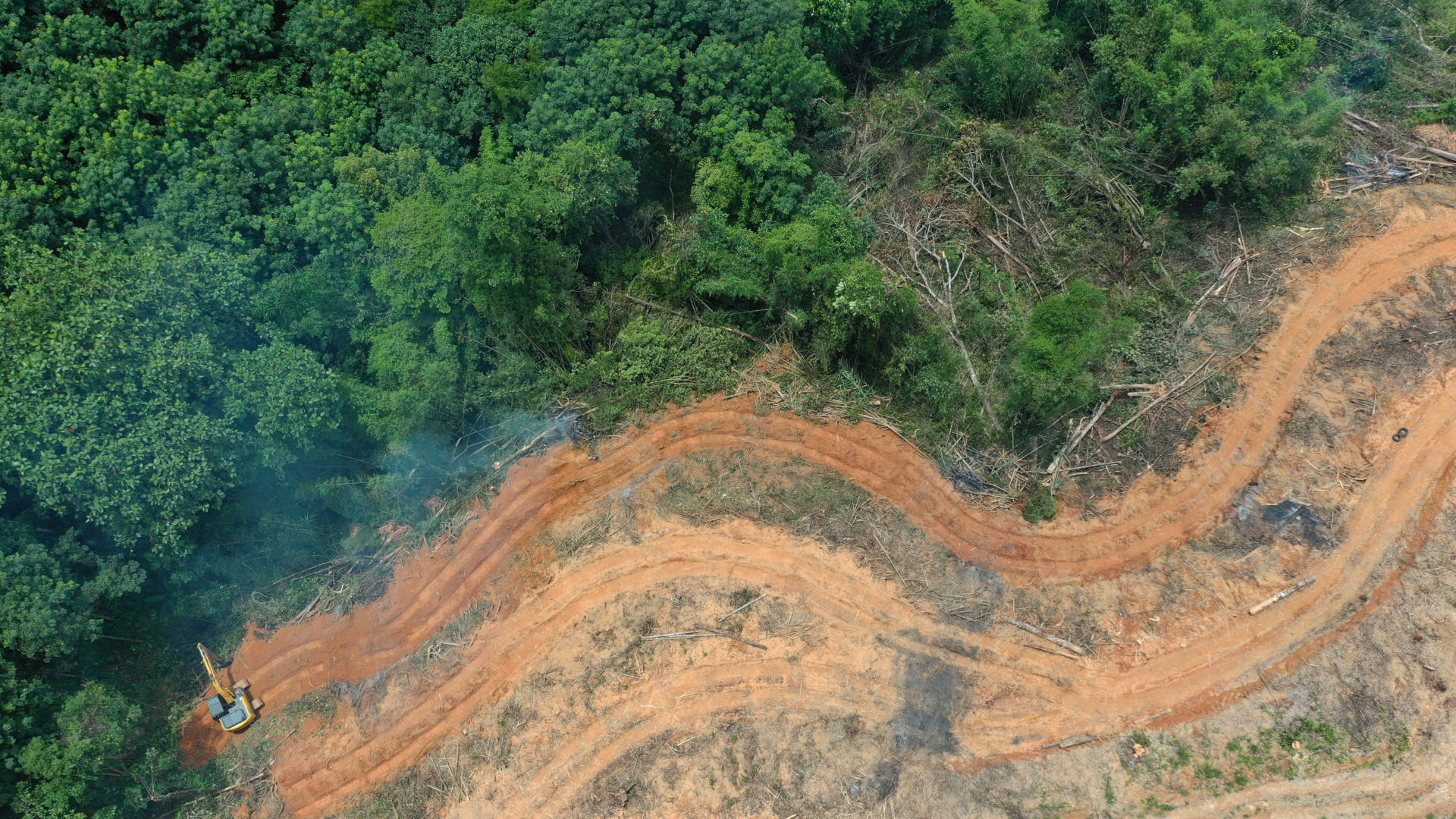
While natural disturbances such as storms and wildfires account for some forest degradation, human activity is responsible for almost all forest loss.
Agriculture takes up almost half of the world’s ice- and desert-free land, which makes it the obvious primary culprit for deforestation. We are still losing around 5 million hectares of forest every year, while progress on reducing deforestation has stalled. As much as 95% of global forest loss occurs in the tropics, and at least three-quarters of this is driven by agriculture, whereby forests are cut or burned down to grow crops or graze livestock. Between 2015 and 2020, Brazil, India, Indonesia, Tanzania, and Myanmar had the five highest deforestation rates of all countries.
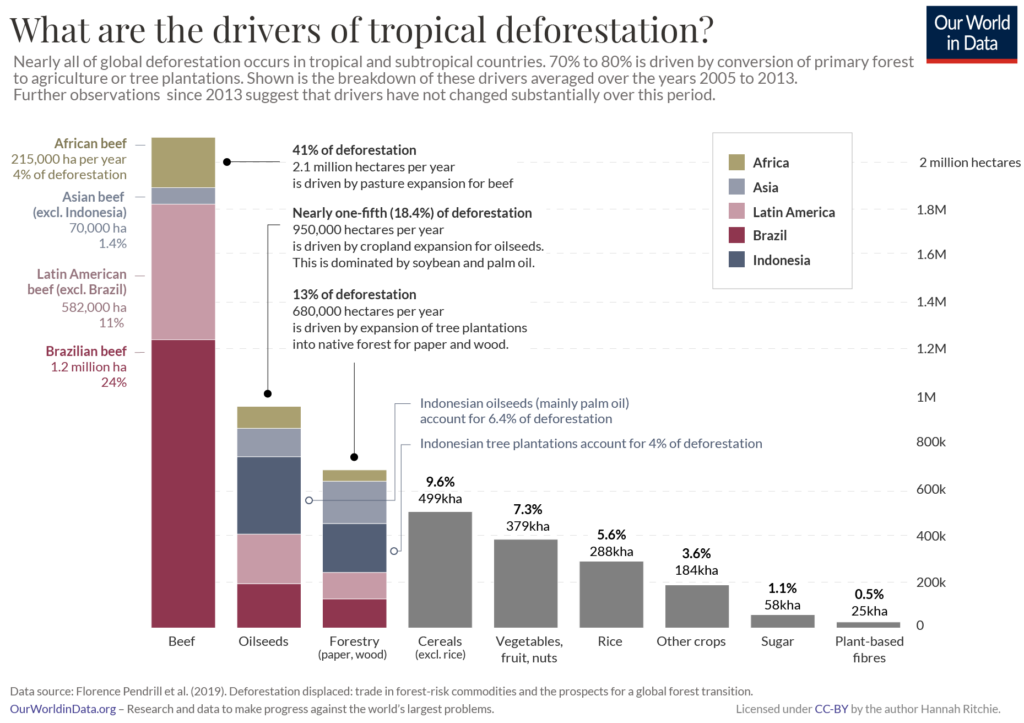
Livestock farming is by far the biggest cause of deforestation. Between 2005 and 2013, pasture expansion for cattle grazing alone was responsible for 41% of tropical deforestation. The second biggest driver, at 18%, is cropland expansion for oilseed crops, which are dominated by palm oil and soybeans. Soybeans are also linked to animal agriculture: an estimated 77% of global soy production is for livestock feed. This means that the most obvious and effective way to reduce deforestation would be to cut back on our demand for meat and dairy products.
In some forest ecosystems, rapid human population growth is also a significant driver of deforestation. In the Congo Basin, aka the “lungs of Africa,” as much as 84% of forest loss between 2000 and 2014 was attributed to small-scale agriculture and clearing for charcoal production by local communities. The countries of the Congo Basin have some of the highest fertility rates in the world. Efforts to improve the status of women, including through addressing unmet need for family planning and removing barriers to girls’ education, are thus key to ending deforestation too.