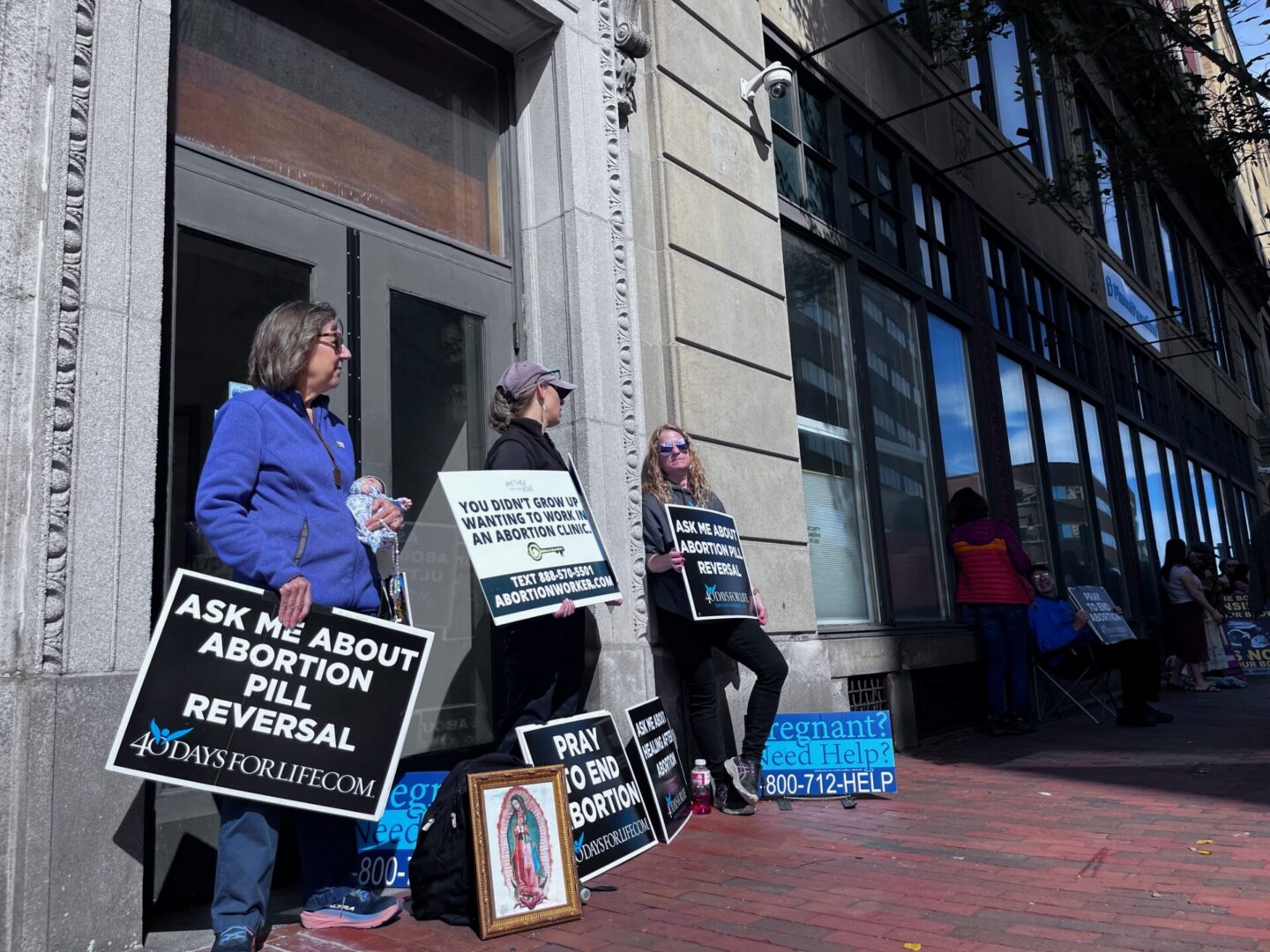
Protesters at the Planned Parenthood clinic in Portland, Maine, during 40 Days for Life, an annual campaign of the Catholic Church.
Photo: Marian Starkey
Four sneaky ways MAGA is trying to undermine reproductive health and rights
Written by Olivia Nater |
Published: April 16, 2026
The Trump administration has overtly and shamelessly enacted drastic policies to curtail access to abortion and contraception both domestically and internationally. But the MAGA movement is chipping away at reproductive health and rights in covert and devious ways too.
Policy sledgehammers
Trump is famously responsible for the June 2022 reversal of Roe v. Wade, which overturned the constitutional right to abortion in the US, enabling dozens of states to enact draconian abortion limits and outright bans. As soon as he barged back into office in January 2025, Trump began launching new attacks on reproductive health and rights.
Domestically, these attacks included the withholding of Title X funds, which help low-income patients access birth control, cancer screenings, and STI testing and treatment. Internationally, Trump’s reinstatement and expansion of the Global Gag Rule has blocked all US foreign assistance from going to any organization, government, or UN agency that provides abortion-related services or information, or that promotes LGBTQ rights, or diversity, equity, and inclusion (DEI). Additionally, Trump has been trying to zero out international family planning aid.
Sneaky tactics
Emboldened by their president, anti-choice groups across the country are trying to weaken access to abortion, while a growing far-right pronatalist movement is seeking to coerce women into giving birth. Many of these tactics use misinformation and manipulation — here are some of the conniving ways MAGA is working to undermine reproductive health and rights.
1) Anti-contraception propaganda
Fear of potential side effects, as well as myths and misinformation about birth control, including that it causes cancer and infertility, have long been a major reason behind the high unmet need for family planning in developing countries. Social media and influencer culture are now also driving women in high-income countries away from hormonal contraception.
Notorious rightwing pronatalist Elon Musk, who claims that small family sizes are leading to “population collapse,” has been using his platform to try to deter women from using hormonal birth control, for example writing on X in February 2024 that it “makes you fat, doubles risk of depression & triples risk of suicide.”
The anti-science MAHA movement is sharing this type of misinformation widely. TikTok, a platform that is particularly popular among young influencers, contains millions of videos from users with zero health or medical expertise claiming that birth control is “toxic,” and encouraging women to stop using it.
It is still unclear to what extent social media is influencing family planning use, but an analysis by The New York Times found that the proportion of women aged 18 to 44 who take hormonal birth control pills fell from 13.1% in 2019 to 10.2% in 2024, perhaps in part because people are switching to long-acting methods like IUDs, but some might also be taking advice from influencers. Presumably, not all of these influencers are politically motivated. Rather, they themselves have been influenced by other influencers. In this digital age, many young people are unfortunately looking to social media for information rather than seeking advice from a medical professional.
2) Mischaracterization and junk science
False information and contempt for science are cornerstones of the Trump administration, which frequently mischaracterizes contraceptives as “abortifacients.” The administration used its anti-abortion stance as an excuse for destroying over $8 million worth of USAID birth control, including IUDs, contraceptive pills, and implants, that were intended for distribution in low-income countries.
In their attempts to impose a national ban on medication abortion (the most common form of abortion in the US), anti-choice organizations are pushing out pseudoscientific papers that claim to have found serious adverse effects from mifepristone (the most commonly used abortion medication), which was approved by the FDA in 2000 and has long been proven to be safe. Some of these papers made it into actual scientific journals but were then subsequently retracted due to serious flaws. A self-published paper by conservative think-tank the Ethics and Public Policy Center (EPPC) received wide attention, prompting the FDA, under RFK Jr’s guidance, to undertake a review on the (well established) safety of mifepristone. There is a real risk that political FDA appointees could pressure the agency’s scientists to ignore mifepristone’s safety and effectiveness in their conclusions and recommendations.
3) Anti-abortion institutions masquerading as health centers
Protesters at the Planned Parenthood clinic in Portland, Maine, during 40 Days for Life, an annual campaign of the Catholic Church. Photo: Marian Starkey
The roughly 750 abortion clinics operating in the United States are vastly outnumbered by “crisis pregnancy centers,” fake clinics that mislead vulnerable people into thinking they provide sexual and reproductive health services. Through deceitful advertising and manipulation of web search results, the more than 2,600 crisis pregnancy centers across the US, propped up by generous funding from anti-abortionists, lure women and girls seeking abortion care, only to try to talk them out of getting the procedure.
Crisis pregnancy centers masquerade as medical facilities, with volunteers wearing lab coats and scrubs, and offer free pregnancy tests and ultrasounds. These deceptive centers don’t need to employ medical professionals because the US does not legally require specialized training to run ultrasound machines. The law also currently does not require crisis pregnancy centers to admit that they are not medical clinics, nor that they don’t provide abortions or birth control.
Crisis pregnancy centers often spread false information about the risks of abortion, including that it causes mental health issues, infertility, and breast cancer, while downplaying the risks of pregnancy and the life-changing impact of having a child. Crisis pregnancy centers also frequently advertise unproven and unethical “abortion reversal” services.
While several states and human rights groups have legally challenged these centers to try to force them to provide their clients with accurate information, the Trump-picked Supreme Court has consistently sided with faith-based organizations that argue attempts at regulation are violations of their First Amendment rights to free speech and religious expression.
Unfortunately, crisis pregnancy centers also receive federal funding, even under pro-choice presidents.
4) Attempts to hijack Title X
Trump is making radical changes to Title X, the federal family planning program for low-income Americans, trying to turn it from a program that helps people access contraception and life-saving healthcare, into a vehicle for advancing his anti-rights pronatalist agenda. During his first term, Trump made it possible for crisis pregnancy centers to receive Title X funding, while all but excluding the participation of organizations that provide abortion services.
This month, the Department of Health and Human Services (HHS) announced that Title X will essentially be turned on its head. The new application guidance explicitly states that applicants cannot use Title X funding to promote or offer abortions, which has always been the case — the Hyde Amendment has prohibited the use of federal funding for abortion for the past 50 years. Now however, the HHS seems to be entirely redefining Title X’s primary goal as helping people to conceive, and doesn’t even mention contraception access as one of its aims:
“This notice solicits applications from public and private nonprofit entities to establish and operate voluntary Title X projects. These projects include a broad range of effective and acceptable services, including pregnancy testing and counseling, basic infertility services, sexually transmitted infection (STI) services (such as HIV prevention education, counseling, testing, and referral), health literacy, reproductive goals counseling to increase optimal health outcomes, and other preconception health services. Title X services also help address and provide referrals for health conditions that affect fertility, including endometriosis, polycystic ovary syndrome (PCOS), and uterine fibroids in women, as well as low sperm count, low sperm motility, low testosterone, and erectile dysfunction in men. [The Office of Population Affairs] seeks a broad competition for Title X grant awards and are interested in innovative strategies to address chronic disease; reduce overmedicalization by strengthening approaches focused on underlying behavioral and lifestyle factors of health and evidence-based practices such as fertility-awareness based methods; promote health and body literacy; advance reproductive goals counseling for all clients; and support family formation.”
The document also emphasizes side effects from modern contraceptives and claims that these have “failed to adequately address the root causes of the nation’s chronic disease burden.”
An HHS spokesperson did not answer a question about whether the new rules still allow the use of Title X funds for hormonal birth control, and said that the HHS is “aligning the program with President Trump’s pro-life and pro-family agenda.”
Resisting the wave of misinformation and manipulation
These alarming developments demonstrate how opponents of reproductive freedom and bodily autonomy are pursuing increasingly sneaky and devious tactics to undermine access to abortion and contraception. As reproductive rights advocates, we must do our best to push back against this wave of misinformation and manipulation — if you learned something from this blog post, please share it with others. Additionally, you can urge your members of Congress to support the Right to Contraception Act, a bill that would protect the right of individuals to use contraception and the right of providers to prescribe and distribute it.
“Pro-life”? Trump’s anti-abortion policies are causing more abortions, suffering, and deaths
Over the past few weeks, the reproductive health and rights community has been rallying against the Trump administration’s reckless plan to spend $167,000 of taxpayer money to incinerate $10 million…
And so it begins: Trump’s attacks on health, rights and the environment
Donald Trump was inaugurated as President of the United States on January 20, 2025. Advocates for human rights, social justice, and the environment had been bracing themselves for an onslaught…

 Fear of potential side effects, as well as myths and misinformation about birth control, including that it causes cancer and infertility, have long been a major reason behind the