
What are the top countries for gender equality?
The world is still far from achieving gender equality, with some countries doing a lot better than others. Here we take a look at which nations have the highest gender…
Read More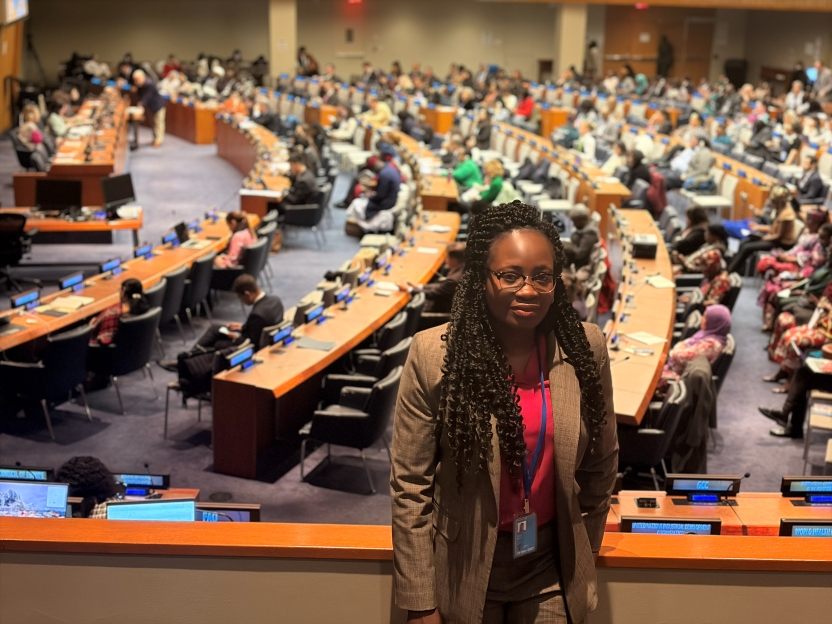
Melvine at CSW70
Written by Melvine Ouyo | Published: April 10, 2026
Population Connection Director of International Research and Policy, Melvine Ouyo, reports on this year’s session of the Commission on the Status of Women, the leading annual international conference aimed at advancing women’s empowerment. This was the first time that Population Connection was represented at the event.
The United Nations Commission on the Status of Women (CSW) is the largest intergovernmental body dedicated to advancing gender equality and women’s rights. Each year, the Commission convenes thousands of global leaders, government representatives, UN agencies, civil society organizations (CSOs), activists, researchers, and youth advocates to assess progress, negotiate policy frameworks and strategies, and accelerate the global agenda for women’s rights. This year’s event, held from March 9-19 at the UN Headquarters in New York City, focused on the theme “Ensuring and strengthening access to justice for all women and girls, including by promoting inclusive and equitable legal systems, eliminating discriminatory laws, policies, and practices, and addressing structural barriers.”

CSW70 hosted about 4,600 CSOs, 190 member states, two heads of state, one vice president, and five prime ministers.
Traditionally, at the end of the conference, member states adopt the agreed draft resolution. However, this year’s session marked a shift from the norm, due to heightened geopolitical tensions, marked by persistent anti-rights positioning from the United States. For instance, the US delegation introduced eight controversial draft proposals that sought to delete phrases relating to gender, sexual and reproductive health and rights, including abortion, as well as DEI. The US delegation maintained that Trump’s administration repeals these terminologies and that those terms do not confer with national laws and policies.
As a result, consensus could not be reached. Member states were forced to vote, and shamefully, the US was the only country that voted against the draft agenda, while another 14 states abstained.
At the end of CSW70, member states, and activists expressed disappointment over not achieving consensus on key resolutions items, including one regarding women, girls, and HIV/AIDS. The US called for a vote on this draft resolution, and was the only member state to vote against it.
The US produced its own lengthy draft resolution intended to re-write the Beijing Declaration, the landmark 1995 UN agreement serving as a blueprint for achieving gender equality. The egregious US draft resolution, submitted a few minutes prior to the deadline, was thankfully blocked by the EU through a ‘no-action motion.’
I was most inspired by the Secretary General, Antonio Guterres, at the Civil Society Townhall. He reminded us that the geopolitical pushback against women’s rights led by the US is just a desperate attempt by the patriarchy to not lose power. He called on women’s rights advocates to never stay silent, and to keep disrupting what needs to be disrupted. His final encouragement and call to action was strong and clear,
“Together we say no to pushback, no to rollback, no surrender, because we will never give up.”
Young people from around the world joined member states in pushing for justice for women and girls. They shared firsthand stories of the suffering and struggle of adolescent girls and youth who are denied justice even when their perpetrators are known to them. Their voices were very clear.
“Justice begins when a girl learns that her body, her voice and her rights matter.”
– Said Sidra, Pakistan.
Speakers called for structural reforms that dismantle harmful practices while creating an enabling environment for access to justice for women and girls.
Jedidah Lemarion, founder of Malkia Initiative, shared stories of Maasai girls who are forced into early marriages by the community. As a Maasai person herself, she was lucky to have escaped circumcision and went on to pursue her education. This was possible because her grandfather was educated.
Aya Chebbi, Founder of Nala Feminist Collective and Former African Youth Envoy, spoke emotionally about the frustrations of young women who are not given the platform to lead even though they have the requisite talent and capacity
Lydia Otieno, a student at Arizona State University, shared with me her frustration at the lack of consensus and the pushback against gender parity at CSW. As a young woman living with disability, Lydia has firsthand experience of the challenges young women face in different communities
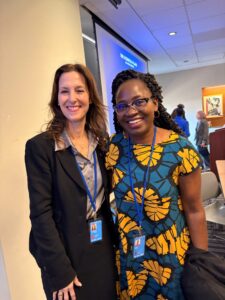
Additionally, I had a very insightful conversation with Brigitte Garceau, a member of the National Assembly of Quebec, in Canada. Her lifetime commitment to justice and equality, and the work she has done to protect vulnerable individuals in her country resonated deeply with me
I also connected with Barbara Jayne Bozeman, president of the National Federation of Business and Professional Women’s Club, whose words about the importance of discernment stuck with me. She explained that understanding our rights and recognizing when systems and authority misuse power should give us the confidence to challenge power and advocate for justice
Gloria Madegwa, an esteemed lawyer and human rights defender, expressed disappointment at this year’s session, but vowed, “We shall not relent. We will keep pushing.”
For some delegates, frustrations began long before CSW70 started. Marilyne Laini, the founder of Nkoko Iju in Kenya, reported that some of her team members were denied visas for the United States. Nkoko Iju works with marginalized communities including female sex-workers and LGBTQI individuals, who have directly suffered the impact of US funding cuts
For other delegates like Noel, the expectation that the UN would provide a safe space proved not to be the case. As a young person working with marginalized LGBTQI communities in China, the significant pushbacks left her threatened and feeling unsafe. “I no longer feel safe sharing my work these days.” This resonated deeply with me, as someone who has worked with diverse communities that experienced the chilling effects of the Global Gag Rule under Donald Trump’s administration.
CSW70 featured about 260 side events organized by different entities including civil society organizations, UN agencies, and research institutions. These convenings provided safe spaces for expression, knowledge sharing, collective resistance, and for strategizing for future disruption. Again, a sign of resilience and determination by activists and human rights defenders to push back against rollbacks, criminalization, authoritarianism, and the shrinking civil space.
UN-Women hosted a landmark session on intersex topics. This was the first ever intersex-focused event at the UN, and it happened amidst rising homophobia and criminalization of LGBTQI people in countries around the world. LGBTQI people in Uganda risk the death penalty, Senegal recently doubled prison terms to 10 year’s jail term, increased fines and criminalized same-sex relations, Ghana’s parliament re-introduced an anti-LGBTQI Bill.
I was most inspired by Nancy Gagnon, Founder and President of Alpha Contact Inc, who has dedicated her life to helping women and girls reclaim their full power, emotionally, psychologically, physically, spiritually, and socially. She reminded us of the importance of self-defense to honor our dignity.
Izadora Letchacoski, a Brazilian-born youth representative from the International Federation of Business and Professional Women called on us to make uncomfortable
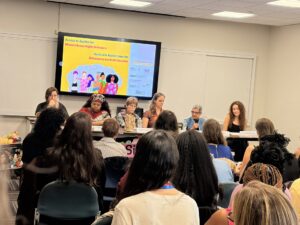
those who make us uncomfortable: “If people make you uncomfortable, give the same back to them, make them uncomfortable.
At another side event exploring access to justice for female human rights defenders, Lopa Banarjee, director of Civil Society Division at UN-Women, reminded us that the attacks we’re witnessing are organized, well-coordinated, and well-funded, “and our response must be justice coordinated, justice strategic, and justice transnational.” She also reaffirmed that UN-Women will not legitimize any order that violates the rights of those the institution seeks to defend.
In another event assessing gender and authoritarian power, speakers expressed concern over the pandemic of violence and called for systemic change, justice, and law enforcement. Cindy Morris, founder of Women Who Change the World, said, “When women gain self-efficacy, we gain self-determination.”
Tonni Ann Brodber, head of secretariat at Women’s Peace and Humanitarian Fund, talked about Haiti’s parliament, which has only three women representatives. She called on women and activists to invade the space because “everything without us is against us.”
The stories written by Sevinc Ozarslan, a Turkish journalist reporting on human rights violations against Turkish women led to her exile in Germany, where she has been living since 2016. One of her harrowing stories was about a woman who was sexually abused and impregnated in police custody.
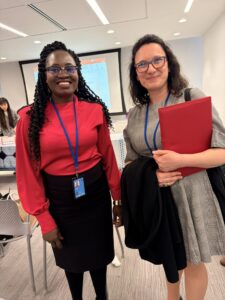
I also attended an insightful conversation on feminist approaches to access to justice. The panel comprised powerful women advocates who called for systemic transformation in legal and governance systems to address violence against women and girls. Izabela Korbiel, a lecturer at the University of Vienna, emphasized the intersection between the criminalization of abortion and the role of the gender data gap in shaping access to justice. She summarized her talk with an inspiring quote that stuck with me:
“Women are 51% of the population, 60% of the poor, 85% of single parents, doing 66% of the work, producing 50% of the food, but earn 11% of the pay and own 20% of the land, while giving birth to 100% of the population.”
Luca Fratini, an Italian diplomat, emphasized, while speaking about justice as a pillar of peace, that access to justice for women and girls requires sustained political will: “Women lead; peace follows.”
During a session about political violence and sexual and reproductive health and rights (SRHR), Wambui E. Kimani, founder of Zamara Foundation, shared NGOs’ challenges dealing with state-backed institutions who champion anti-right policies. She noted that NGOs are currently experiencing renewed backlash, putting a target on pro-rights activists. Wambui noted that while women’s rights funding is being restricted and cut, anti-rights groups remain well funded.
As a result of concessions and oppositions, CSW70 adopted neutral conclusions maintaining the Commission’s focus on expanding access to justice and empowering women and girls, without any major progress.
In her final remarks, Sima Bahous, Executive Director of UN-Women, said that the Commission would continue to deliver on the promises of the Beijing Declaration and pursue access to justice for women and girls.
Many civil society representatives, including Population Connection, left the conference feeling very frustrated. During a time when bold action is urgently needed, CSW70 failed to meaningfully move the needle in the right direction.
CSW70 reaffirmed a worrying reality that rights can be rolled back a lot faster than they were achieved. Furthermore, this session revealed that access to justice is not simply a technical agenda, but a political choice. The global feminist community must remain steadfast and courageous to defend gender equality and justice for women and girls. There can be no surrender!
