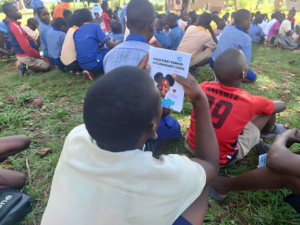
FlowReady outreach at Makembo Primary School in Mayuge District.
Preparing girls for menarche and fighting period poverty: Q&A with FlowReady
Written by Olivia Nater |
Published: May 25, 2026
Through our Global Partners program, Population Connection supports a growing number of grassroots organizations around the world working to increase access to education, public health and family planning services. Their efforts make a vital difference in their local communities and represent the “final step” in our shared work to make the world a more just and sustainable place for everyone.
Get to know our wonderful partners in this Q&A series! Florence Blondel, Population Connection Digital Media Manager and Founder and CEO of FlowReady tells us about her organization’s efforts to improve menstrual education and combat period poverty in rural Uganda and beyond.
What prompted you to start your organization?
Florence (center) with FlowReady board members during a pad drive for a women’s shelter in Charlotte, NC.
FlowReady was born from both personal experience and a growing realization that far too many girls experience menstruation in fear, confusion, and silence.
Growing up in Uganda, menstruation was rarely discussed openly. When I first started menstruating, I didn’t have the luxury of pads, privacy, or even adequate sanitation. We lived in a crowded one-room rental shared with multiple family members, and several households relied on a single outdoor latrine and bathroom. Water was scarce and carefully rationed. Like many girls facing period poverty, I improvised using pieces of my old green school uniform as makeshift pads because I did not know what else to use.
I also didn’t fully understand what was happening to my body or how to manage it safely. I remember the anxiety of staining my clothes, silently enduring pain and discomfort, and carrying the shame and isolation that so often surrounded menstruation. Those experiences stayed with me long into adulthood.
As I got older, I realized my experience was not unique.
Many girls still reach menarche (their first period) completely unprepared — sometimes believing they are sick or injured, missing school, or facing stigma and harmful expectations. In some places, a girl’s first period is still wrongly seen as a sign that she is ready for marriage or childbearing.
That realization stayed with me deeply: What if girls were prepared before their first period ever happened?
That question became the foundation of FlowReady. We focus on pre-menarche education — preparing girls before menarche with knowledge, confidence, dignity, and support. But our work also extends beyond girls themselves. We engage boys, parents, teachers, and communities because lasting change requires community-wide conversations around menstruation, gender norms, and girls’ wellbeing.
Over time, what began as something deeply personal evolved into a broader mission: helping girls navigate menstruation with confidence while challenging the harmful beliefs that continue to limit girls’ opportunities.
What programs or projects are you currently working on?
We are currently working on several interconnected initiatives in Eastern Uganda, particularly in Mayuge District.
Makembo Primary School student learning how to use a reusable pad.
One of our core programs is school-based menstrual health education and distribution of FlowReadyNow kits, which include reusable pads, underwear, soap, toilet paper, storage pouches, and our FlowReady Period Guide. We work closely with senior women teachers, health workers, and local partners to ensure girls receive both practical support and accurate information.
We are also focused on local engagement. We’ve held dialogues with parents and guardians, conducted home visits, and intentionally included boys in menstrual health conversations. At one school, we even recruited boys as “menstrual ambassadors” to help reduce stigma and support girls in their learning environment.
A major recent initiative has been our 12-week Lusoga-language radio show, Ekiseera Ky’Omughala (“A Girl’s Time”), airing on 92.5 Your Voice FM in Mayuge. The show reaches far beyond classrooms and allows us to bring conversations about menstruation, myths, early marriage, and girls’ wellbeing directly into homes and communities. We’ve been encouraged by the number of fathers, teachers, and community members participating through live call-ins.
We are also continuing follow-up work in schools where we previously conducted outreach, because we believe long-term trust and continued engagement matter more than one-time interventions.
Boy reading a FlowReady period guide during outreach at Makembo Primary School.
We are preparing for Menstrual Health Month activities in May, with five days of outreach and community engagement planned in Uganda. The activities will include school sessions, community dialogues, menstrual health education, media engagement, and distribution of menstrual hygiene supplies as we continue encouraging more open and supportive conversations around menstruation.
This year also marked an important milestone for us in the United States. FlowReady held its first menstrual health activity in Charlotte, organizing a menstrual product drive supporting Safe Alliance, a women’s shelter, and a local community pantry. The response from supporters and neighbors was incredibly encouraging, and we hope to make it an annual initiative.
The experience also reinforced something important: menstrual health challenges exist everywhere, including in the United States. Research shows nearly one in four teens in the U.S. have struggled to afford period products, while an estimated 12 million people experience period poverty nationwide. Rising costs of menstrual products have also made access increasingly difficult for many families.
These experiences continue to reinforce our belief that menstrual health is not a niche issue, but a broader matter of dignity, health, education, and equity.
What do you hope to achieve in the next five years?
Over the next five years, I hope FlowReady can grow into a sustainable, community-rooted organization that helps reshape how girls experience menstruation and adolescence across Uganda and eventually beyond.
I would love to see pre-menarche education normalized so that no girl faces her first period in fear or confusion. I hope we can expand our school and community outreach to reach thousands more girls, especially in underserved rural communities.
FlowReady Partnerships and Advocacy Manager, Lea Bwanika, talking to girls during an outreach session in Mayuge.
I also hope to strengthen our advocacy work around harmful norms linked to menstruation, including stigma, school absenteeism, child marriage, and misconceptions about girls’ readiness for adulthood.
Another goal is to build stronger partnerships with educators, health professionals, local leaders, and media platforms so menstrual health conversations become more open and community-wide. I would also like to see FlowReady develop more research and storytelling capacity to document the lived experiences of girls and elevate local voices in global conversations around reproductive health and development.
Ultimately, success for us would mean girls feeling informed, supported, confident, and able to stay fully engaged in school and community life — without menstruation becoming a barrier to their future.
What have been some of the greatest challenges you have faced?
One of the greatest challenges has been building a small grassroots organization with limited resources while trying to address issues that are deeply rooted in culture and stigma. Conversations around menstruation can still be uncomfortable, especially when discussing young girls, puberty, or reproductive health in conservative settings.
Funding is another challenge. Like many small nonprofits, we operate with a lean structure and rely heavily on volunteers, partnerships, and community trust. Balancing ambitious goals with limited staffing and financial capacity can be difficult.
There have also been logistical challenges working across communities with limited infrastructure, transportation barriers, and inconsistent access to sanitation facilities.
At the same time, one of the emotional challenges is hearing the stories girls share — stories of fear, shame, teasing, or feeling unsupported. Those experiences are heartbreaking, but they also reinforce why this work matters so much.
One challenge that has surprised me is that menstrual education barriers are not limited to Uganda or low-resource settings. Even in the United States, conversations around menstruation and puberty can still be uncomfortable or heavily restricted in school environments.
As we began exploring outreach opportunities in North Carolina, I was told by a principal and school counselors at a neighboring elementary school that menstruation was essentially a “no-go” topic at that level. The discomfort among some parents and educators around puberty education is very real, and broader debates around school curricula have also created hesitation in some spaces around discussing reproductive and menstrual health openly.
Research in the United States has similarly found that menstruation and puberty education are often inconsistent, delayed, or pushed aside in schools, with many teachers reporting discomfort or inadequate preparation around the topic.
For me, these experiences have reinforced that menstrual stigma is a global issue. Whether in Uganda or the United States, many young people are still entering puberty without the knowledge and support they deserve.
What are you most proud of?
FlowReady Team refurbishing the school Period Safe Room with basic necessities like sheets, buckets, emergency pads, pain medication and soap.
I’m most proud that FlowReady has created spaces where conversations that were once considered embarrassing or taboo are finally happening openly.
I’m proud of the girls who now say they feel prepared and confident. One of the other things I’m most proud of is seeing boys read our menstrual health guide openly and without shame. I’m proud of parents and fathers calling into our radio program wanting to learn how to better support their daughters.
I’m also proud that despite being a young organization, we’ve built meaningful trust within communities. Seeing schools welcome us back, teachers continue the conversations, and communities ask for more engagement has been incredibly encouraging.
On a personal level, I’m proud that something that began as a concern rooted in my own lived experience has grown into a movement that is helping other girls feel seen, informed, and supported.
Anything else you’d like to share with Population Connection members?
I’m deeply grateful to Population Connection and its members for recognizing the importance of grassroots, community-led work.
Lea Bwanika talking with a school boy during a FlowReady outreach session.
Menstrual health is often treated as a niche issue, but it intersects with education, reproductive autonomy, gender equality, public health, and long-term development outcomes.
One thing I’ve learned is that small interventions can have ripple effects far beyond what we initially imagine. Preparing a girl before her first period can influence her confidence, her ability to stay in school, how she sees herself, and how her community sees her.
I would also encourage people to listen closely to local voices and lived experiences. Some of the most powerful insights come directly from girls, teachers, parents, and community members themselves. Sustainable change happens when communities are part of shaping the solutions.
We are still growing, learning, and building, but we remain deeply hopeful about what becomes possible when girls are equipped with knowledge, dignity, and support from the very beginning.
I’m also encouraged by the growing recognition of menstrual health within global policy conversations. Last year (2025), I attended the 58th session of the UN Commission on Population and Development (CPD58) on behalf of Population Connection, where menstrual health was discussed more visibly than I had seen ever in that space.
Experiences like CPD58 have further inspired me to think about how FlowReady can contribute not only at the community level, but also within broader international conversations around girls’ well-being and development. As we continue growing, I’m especially excited about the possibility of eventually engaging more formally within UN spaces to help elevate grassroots perspectives and lived experiences from the communities we serve.
A women-led movement for a better future: Women for Conservation field report
Population Connection Senior Analyst Hannah Evans reports on a site visit to El Dorado Nature Reserve in the Sierra Nevada with Women for Conservation, our Global Partner based in Colombia.…
Visiting our Global Partners in Guatemala: Manos Abiertas Field Report
My journey to Guatemala In March, I set out on a journey to visit Population Connection’s amazing Global Partners in Guatemala. The experience was both inspirational and transformative, and a…