
Is overshoot my burden?
One mom’s journey to raise an environmentally aware child amid climate anxiety and the burden of ecological overshoot — through everyday choices and empowered parenting. Last week (on World Population…
Read More
Written by Florence Blondel, Digital Media Manager | Published: January 12, 2026
What does it mean when some countries use more than their fair share of Earth’s resources in weeks, while others never overshoot at all?
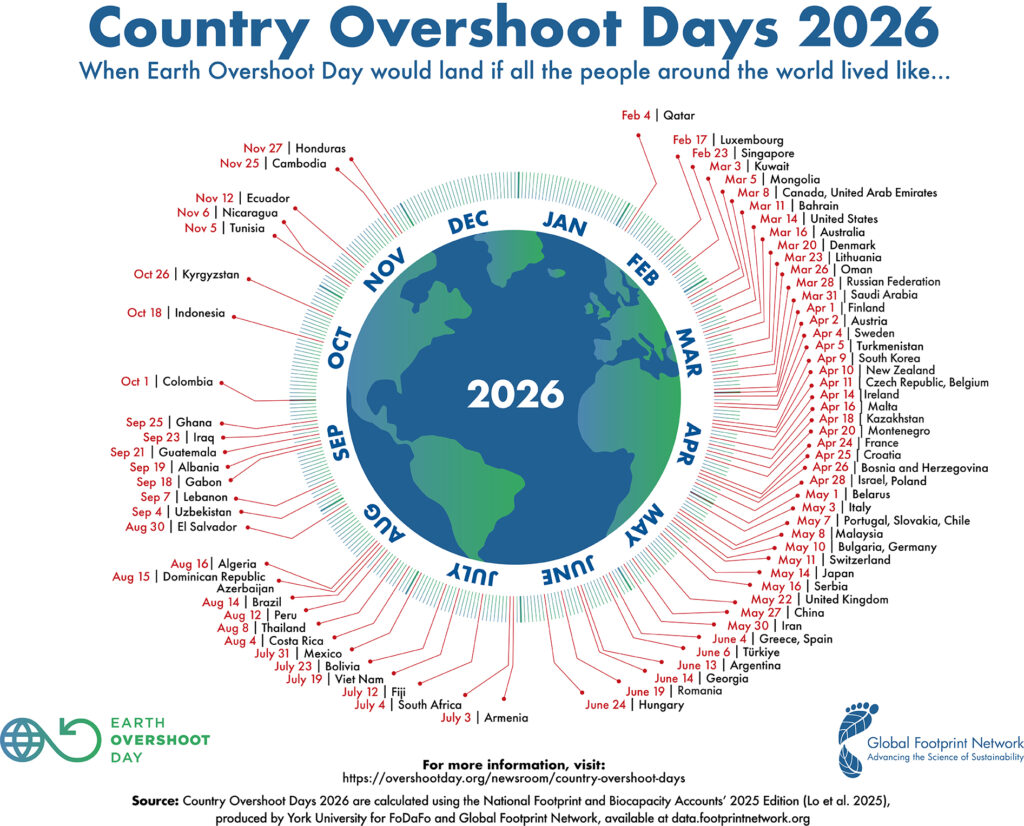
Global Footprint Network has just released updated data on Country Overshoot Days and Ecological Deficit Days, highlighting when nations exhaust their annual ecological resources. To understand what these dates actually represent — and why they matter for our planet’s future — we spoke with Mathis Wackernagel, Co-founder and board member of Global Footprint Network.

Population Connection: Mathis, thank you for joining us. For our readers who may be new to the concept, can you explain what a Country Overshoot Day is and how it’s calculated?
Mathis: A Country Overshoot Day is the date when humanity would have exhausted what Earth can renew in the entire year, if everyone lived like people in that country. So, it’s really asking: how many Earths would we need if the world lived like us?
We calculate it by comparing a country’s Ecological Footprint per person, or how much nature people use, with how much the planet can regenerate per person. This ratio then can be translated into time. For instance, if a country’s per person demand was threefold of what the planet can regenerate per person, then it would take one third of a year to exhaust the yearly budget.
Also, we focus on the mother of all resources: biocapacity or the ability of ecosystems to renew. This limits everything: how much food and fibers we can get, how much CO2 can be absorbed (which limits our fossil fuel use), and how much we can mine (because the amount of nature it takes to access the minerals is more limiting than the underground minerals).
Population Connection: Why are Overshoot Days such a powerful way to communicate sustainability challenges, compared to traditional indicators like emissions or GDP?
Mathis: Because everyone understands a deadline on a calendar. Saying we’ve already spent this year’s ecological budget by March lands very differently than talking about abstract percentages or tons of emissions.
It also connects our economies to physical limits. GDP can grow for a while even when we are depleting natural capital, but Overshoot Days show whether our economies are operating within ecological means or undermining our prospects. It reframes sustainability from being about sacrifice to being about long-term viability.
Population Connection: The 2026 Country Overshoot Days highlight stark differences. For instance, Qatar overshoots on February 4, while lower-income countries like Bangladesh or Nigeria have no Overshoot Day. What do these extremes reveal about inequality in global resource use — and why do some lower-income countries never reach an Overshoot Day at all?
Mathis: It shows just how unequal global resource use is. Early overshoot usually reflects very high per-person consumption — energy, materials, and carbon. Countries without an Overshoot Day are using less than what global ecosystems can regenerate per person.
But that doesn’t mean life is easy there. Often it means people lack access to energy and services. But this points to the essence of what we are after. If countries are not putting resource security at the core of their economic development strategies, they are in our view on a self-imposed suicidal path, and again here we think of the regenerative resources primarily.
Resource security is at the center of producing lasting human wellbeing. And it is the latter that is the ultimate goal.
Population Connection: Looking at the latest country results, what patterns stand out — and are there any trends that worry you or give you cautious optimism?
Mathis: Most high-income countries overshoot early.
The good news is that some countries are starting to recognize that waiting for others is self-defeating. They are bending their resource curves through cleaner energy, efficiency, and smarter cities. The not-so-good news is that globally, we’re still moving deeper into overshoot; progress just isn’t fast enough yet.
Population Connection: You mentioned Ecological Deficit Days in the release. What are they, and why should we pay attention to them?
Mathis: Ecological Deficit Days mark when a country has used more than its own ecosystems can regenerate in a year. After that point, it’s living off imports, depleting its natural capital, or exporting waste like CO₂ to the global commons.
That’s not just an environmental issue. It’s an economic risk. Countries running persistent deficits are more exposed to supply disruptions and rising resource costs. Overshoot Days show whether the country’s development model is globally replicable. The Deficit Days show whether countries, in net terms, are resource sinks or resource providers.
Population Connection: Taken together, what do Country Overshoot and Deficit Days tell us about where the world is headed — and how urgent course correction really is?
Mathis: They tell us we’re using nature faster than it can renew — and that’s not a recipe for long-term stability.
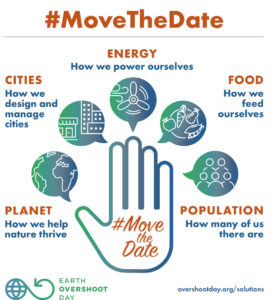
But they also tell us overshoot is the result of human choices, not fate. Change the energy system, food system, and city design, and the date moves. The sooner we act, the more room we have to maneuver.
And the most important thing they tell us, and the fewest hear, is that we are not stuck with conflicting incentives. Not to prepare oneself for the inevitable future of climate disruption and resource constraints is just plainly self-defeating. To understand this, we do not need to go to climate COP meetings. Actually, going there may give us the impression that we are powerless and need to wait for everyone else first, and that is just a false reading of the current situation.
Population Connection: How can countries move their Overshoot Days later in the year? What role can civil society organizations like Global Footprint Network and Population Connection play?
Mathis: There are some big, proven levers: switch to clean energy, design compact and efficient cities, reduce food waste, eat lower on the food chain, and invest in healthy ecosystems. Many of these changes also improve quality of life. We call them the power of possibility.
Civil society organizations are also contributing. For instance, by helping to turn data into action — supporting smart policies, engaging communities, and keeping the focus on solutions that actually move the date.
Population Connection: Your data shows that consumption levels matter as well as population size. How should we think about population dynamics alongside per capita consumption when planning for long-term sustainability?
Mathis: All factors matter. A country’s resource security is determined by how many people they are, how much they consume per person, and how large the country’s biocapacity is. So, all offer leverages for intervention.

Sustainability becomes more possible when addressing all factors: protecting and restoring nature’s ability to regenerate, reducing excessive resource dependence (mostly by lowering demand), and supporting education, health care, and family planning so populations can stabilize or even slowly decline in ways that are voluntary and empowering. Given that humanity would do better moving out of fossil fuels, the resource gap will be even larger. But the alternative is even tougher.
There has been quite a bit of buzz lately popularizing worries that our reproduction rates are too low. I think most of those buzzers may not recognize that our current resource throughput is about three times too large compared to a flow that Earth could maintain. This also includes the necessity to move out of fossil fuels which now provide humanity with about 60% of the material and energy input. So to believe we can just maintain what is now we could call naïve or reckless.
Population Connection: Finally, if you could send one key message to readers about Country Overshoot and Deficit Days, what would it be?
Mathis: Overshoot is not a verdict — it’s a measurement. And what gets measured can be managed more effectively. We already know how to move the date, and many of the solutions make societies healthier, more resilient, and asset rich. The real question is how quickly we choose to implement them at scale. Waiting is the dumbest, most costly, and most self-defeating strategy.
Learn more about how population dynamics intersect with ecological overshoot at Global Footprint Network’s population and solutions hub, and explore how Population Connection works to advance sustainability through education, advocacy, and rights-based family planning.