
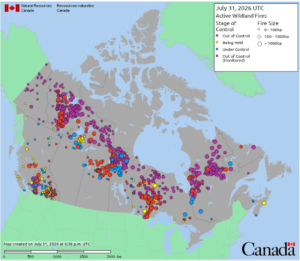
Canadians may be renowned for their politeness, but the United States has been visited this summer by innumerable rude neighbors from the North. Crossing our shared border with impunity, massive quantities of microscopic particles from remote Canadian forest fires have smeared our skies and fouled our lungs.
Almost 900 wildfires are burning across Canada. Some are astonishingly large. A single fire can grow larger than the entire state of Delaware, with some blazes burning hundreds of miles from the nearest road.
Canada contains more than a quarter of the world’s boreal forests—vast realms in the coldest regions consisting primarily of conifers. They serve as one of Earth’s great carbon vaults, storing enormous quantities of carbon in trees, soils, permafrost, and deep peat deposits accumulated over thousands of years.
When permafrost thaws or massive fires burn through deep peat layers, they open those carbon vaults. Wildfire smoke is unpleasant—even dangerous—but the vastly larger threat comes from greenhouse gases released into the atmosphere. During Canada’s extraordinary 2023 wildfire season, emissions were so great that researchers estimated the fires ranked among the world’s largest sources of carbon emissions.
Forest fires themselves are a natural phenomenon, and efforts at suppression can result in the accumulation of combustible vegetation—transforming a lightning strike into a raging inferno before firefighters can reach remote locations. What’s new is the surge in exceptionally large wildfires directly related to climate change, which creates hotter, drier conditions that desiccate trees, peat, and soils. Earlier snowmelt, later freezes, more frequent droughts, and worsening fire weather all contribute to fires that spread faster, burn hotter, and cover vastly larger areas. The result: a self-reinforcing cycle: larger wildfires release enormous quantities of carbon dioxide, further accelerating warming and increasing the likelihood of future extreme fire seasons.
Climate change is driven by our continued dependence on fossil fuels in a world where population has tripled over the past 75 years and continues to grow rapidly. More people consuming more resources inevitably place greater pressure on the atmosphere, forests, water supplies, and other ecological systems.
Yet some politicians seem more interested in blaming smoke than addressing its causes. US Rep. Lisa McClain (R-MI), chair of the House Republican Conference, recently posted on social media:
Michiganders shouldn’t have to breathe Canada’s negligence. YEAR AFTER YEAR the smoke crosses the border while Canada does nothing. Stop exporting your smoke into our skies.
Donald Trump predictably added his own inane comments, saying that “the United States is being unnecessarily invaded by filthy, polluted, and unhealthy air,” and publicly threatened linking tariffs to the costs of wildfire smoke pollution. Political adviser Katie Miller—wife of Stephen Miller, the White House deputy chief of staff—chimed in, posting on X : “This is why Canada should be the 51st state.”
The reality is that no one can simply wish these fires away. Confronting climate change requires confronting its causes in our overcrowded world. And that clearly and unequivocally includes population growth—past, present, and future.