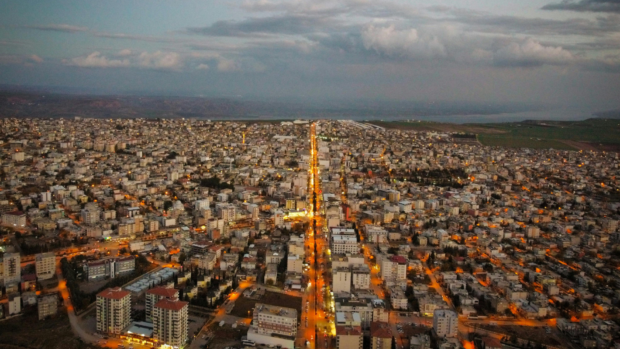
Earthrise—the rising Earth greeted the Apollo 8 astronauts on December 24, 1968 as they came from behind the Moon after the fourth nearside orbit.
NASA
How many people can Earth support?
Written by Olivia Nater |
Published: October 30, 2026
Is our world overpopulated? How many humans can actually live on Planet Earth, and is there a specific sustainable population size we should aspire towards? These are common questions that this article attempts to address.
What is carrying capacity?
Carrying capacity is an ecological term commonly used in wildlife biology and management, defined as the maximum number of individuals of a particular species an environment can sustain indefinitely.
Scientifically, carrying capacity is denoted by the variable K. In general, when a population size is well below K, it grows exponentially, and then slows down as it nears K, resulting in a typical S-shaped (logistic) growth curve. When a population reaches K, the growth rate is zero, i.e., an equal number of births and deaths.
Is there a human carrying capacity?
As our planet is finite, all species on Earth have a carrying capacity. The concept is trickier to apply to humans, however, because of how heavily we can modify our environment for our benefit. For example, modern technology allows us to grow vast quantities of food on limited land, divert and dam rivers to supply our freshwater needs, and burn fossil fuels to generate power.
Fossil fuels in particular have made it possible to overshoot natural resource limits, enabling dramatic increases in population and consumption that would not have been possible during pre-industrial times.
Another reason the carrying capacity for humans is difficult to determine is due to extreme inequalities and differences in how people live. Individuals within a troop of chimpanzees have roughly similar lifestyles, diets, and resource demands, but a human billionaire consumes vastly more resources and places more strain on the environment than someone living below the poverty line.
Many have tried to calculate a human carrying capacity or “maximum” population size for the world, with very different outcomes due to the many variables and assumptions involved. If we’re using carrying capacity in its strictest scientific sense — a population size forcefully capped by nature’s limits — reaching it would not be very pleasant. A more useful exercise is to ask ourselves what a sustainable or “optimum” population range might look like — how many people could the Earth support over the long term, with everyone having a decent quality of life, and without compromising the needs of other species and future generations?
Is Earth overpopulated?
While we may not (yet) have reached our maximum carrying capacity (K) because our global population is still increasing (births still outnumber deaths), the planet’s vital signs reveal that our current size of 8.3 billion and counting is certainly not sustainable.
We are collectively using natural resources 1.7 times faster than they can regenerate, and we have already breached seven of nine critical planetary boundaries. Our biggest environmental crises, from climate change, to biodiversity loss, to resource depletion and pollution, are still worsening, and scientists have warned that we are rapidly approaching catastrophic tipping points.
In other words, based on current average consumption levels, and the fact that these are projected to increase further as a result of declining poverty, it’s hard to argue that we are not overpopulated.
What would be a sustainable human population size?
The question of what a sustainable population size might look like depends on how much each of us consumes. Our planet is finite, and while technology can temporarily stretch the limits to growth, the bigger the population, the smaller everyone’s share of arable land, resources, fresh water, etc. While we should not aspire to live like billionaires, nobody wants to live in poverty either.
Several researchers have attempted to calculate how many people could live on Earth assuming everyone has their basic rights and needs met.
A 1994 study by Gretchen Daily and Anne and Paul Ehrlich suggested that an optimum population size might lie between 1.5 and 2 billion people. They arrived at this figure by determining a level of per capita energy consumption that would enable a comfortable, mid-twentieth-century European standard of living with access to modern medicine, high-quality education, adequate nutrition, and technological/artistic creativity, but without the hyper-consumerism of rich nations like the United States.
The authors found that at this level of energy consumption, exceeding the 2 billion benchmark would require exhausting finite fossil fuel reserves and cause ecological breakdown, including biodiversity loss and climate destabilization.
A 1999 paper by Pimentel et al. used a similar approach. Based on a decent European standard of living for everyone and allocating a certain amount of land, energy use, and fresh water per person that would avoid depleting renewable and non-renewable resources, the researchers concluded that an optimal global population would stand at around 2 billion.
Renowned economist Partha Dasgupta has attempted to calculate a sustainable human population size based on different income levels as a proxy for consumption. In a 2021 paper, Dasgupta et al. determined that an acceptably high global living standard of $20,000 per capita (in 2011 prices, which equates to roughly $30,000 today), assuming equal distribution, would enable a sustainable global population (without depleting natural capital — nature’s goods and services) of roughly 3.3 billion people.
The authors also looked at how much this living standard would need to contract if our population reaches 9 billion by 2100. In this case, everyone would need to get by on $11,840 per year (approximately $17,700 in today’s dollars). Instead, our global population is projected to increase to over 10 billion by 2100, which would require further contraction in average income to achieve long-term sustainability.
A study published this year by Bradshaw et al. takes an unusual approach by not utilizing any measure of consumption or biocapacity to calculate maximum and sustainable population sizes. The paper categorizes the historical human population trajectory into two phases: the first, from 1800 to 1949, marked by a strong positive correlation between human population size and growth rate, which was fueled by industrialization, improvements in healthcare, and the scaling of fossil fuel energy (the “facilitation” phase), and the second, beginning in 1962, defined by a negative relationship between population size and growth rate (the “negative” phase). The authors interpret the divergence between the growth rate and the increase in population size as a sign that we reached environmental limits. This roughly coincides with when we entered into ecological overshoot, according to research and calculations by the Global Footprint Network.
The authors employed a model used in population ecology to extend the negative phase until it reaches a zero growth rate (which marks K), leading to an estimated maximum carrying capacity of 11.7–12.4 billion people. They then identified the end of the facilitation phase (which they interpreted as a sign of human flourishing) to arrive at an estimated maximum sustainable population size of 2.5 billion. Bradshaw et al. noted that if we were to aim to use resources at a rate of just 0.5 times as fast as they can be regenerated (as opposed to our current rate of 1.7), this would require dividing our current population size by around 3.4, which yields a similar sustainable population size estimate of 2.4 billion.
You can watch the lead author’s explanation here:
The paper drew criticism, most obviously because the mid-century slowdown in the global population growth rate was driven primarily by access to modern contraception and voluntary choices, rather than environmental constraints. The authors nevertheless maintain that the widespread adoption of family planning was at least partly a response to the stress of approaching planetary boundaries.
Can we achieve a sustainable population?
While it’s important to keep in mind that these sustainable population size suggestions are all rough estimates, it is nevertheless notable that they all fall below 4 billion, which is less than half our current population size. Indeed, another study published earlier this year advocates for shrinking our global population to 4 billion, which the authors say is achievable by 2200 under an optimistic scenario that assumes rapid progress in removing barriers to family planning and girls’ education.
This paper, which looks at actual population projections and their feasibility, makes it clear that achieving a sustainable population size is necessarily a very long-term goal. While those of us alive today may never see a global population living in harmony with the natural world, we owe it to future generations of humans and other species to do our best to get ourselves on the right path. Not to mention that pursuing empowering population solutions is critical from a human rights perspective, reducing inequality and improving the quality of life and standard of living for people who are alive today.
A world of 4 billion? Researchers recommend shrinking our global population by more than half
A new study published in the journal Sustainable Development makes the case for gradually shrinking our (still growing) population of 8.3 billion to 4 billion or fewer by 2200, demonstrating…
Major UN report highlights overpopulation and overconsumption, need for profound transformation
A major new review of the state of the environment by the United Nations Environment Programme (UNEP) provides a comprehensive and refreshingly honest exploration of the root drivers of environmental…

 As our planet is finite, all species on Earth have a carrying capacity. The concept is trickier to apply to humans, however, because of how heavily we can modify our environment for our benefit. For example, modern technology allows us to grow vast quantities of food on limited land, divert and dam rivers to supply our freshwater needs, and burn fossil fuels to generate power.
 A 1994