Marian Starkey enjoying a hike in the White Mountains with her dog, Penny
September 2025
Bucking the Life Checklist: college, marriage, motherhood
Written by Florence Blondel |
Published: July 31, 2026
“Why did your husband not leave you? Were his options that bad? Refusing to have children when the other partner wants them is a good reason for the child-wanting person to get a divorce.”
That was one of the comments left on our YouTube channel beneath an episode of Other Than Motherhood, a podcast exploring the growing childfree movement, featuring two of our staff.
The comment was directed at Marian Starkey, Population Connection’s Vice President for Communications, who shared that she had decided in high school that she didn’t want children, with a certainty that surprised her eventual husband, whom she began dating when she was 18. “Anyone who listened to the interview would know that I had already made up my mind about this before even meeting Alex.”
Such comments reflect an enduring belief that adulthood follows an unspoken checklist: go to college, get married, have children. Deviating from that script is often met with suspicion, criticism, or pity. Increasingly, however, psychologists and sociologists have found that adults who intentionally remain childfree report lives that are just as satisfying and meaningful as those of parents. What they experience more often than regret is frustration with the social stigma.
While choosing not to have children has become more socially accepted in recent years, as we commemorate International Childfree Day, we’re exploring why a deeply personal reproductive choice continues to provoke such strong reactions.
Childfree doesn’t mean anti-child
Marian and her husband, Alex, in Dubrovnik, Croatia, in May 2026
One of the most striking moments in the podcast conversation mentioned above was how Marian challenged one of the biggest misconceptions about childfree adults: that they simply don’t like children.
Marian has now spent nearly 20 years working in communications for Population Connection. But before that, she spent over 10 years caring for children—babysitting, working as a professional nanny, and even considering a career in family therapy. She has always loved being with kids and is “auntie” to many of her friends’ children.
Ironically, those experiences helped her realize that motherhood wasn’t the life she wanted for herself.
“But through caring for kids day after day and being responsible for them for entire days at a time, I realized something important. I realized that wasn’t the life I wanted for myself.”
She explained that spending so much time caring for children showed her how rewarding but also how demanding parenthood can be. Loving children, she realized, is not the same thing as wanting to become a parent.
Realizing parenthood is optional
Nandita Bajaj, Executive Director of Population Balance, moderated a webinar this week for International Childfree Day (entitled “A Panel on Confronting Pronatalism”) where she spoke of her own path to a childfree life. While Marian’s experience highlights the difference between loving children and wanting to become a parent, Nandita illuminated another important dimension of the childfree choice: that parenthood does not need to be the default for all couples.
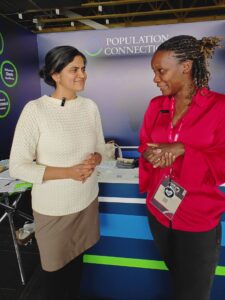
Nandita Bajaj (left) and Florence during the International Conference on Family Planning (ICFP) in Bogotá, Colombia, November 2025
For her, the realization that she could choose not to have children came unexpectedly, not from a personal crisis or a rejection of family, but from a conversation with her husband. When he said, “This is a decision we make together. You do not have to have children,” she was struck by two conflicting emotions: joy at discovering a freedom she had never considered, and shock that, as a feminist, aerospace engineer, and independent thinker, she had reached adulthood without realizing she had a choice.
“And my response then was, are you serious? Can we not have kids? It didn’t take us long to decide that we wouldn’t have children.”
She later asked, “Why did I think that motherhood was an inevitability, and how many others were there who like me didn’t know they had a choice?” That question led her to explore how pronatalist expectations shape people’s reproductive decisions and how social, cultural, and political pressures can present parenthood as an obligation rather than a choice.
Together, Marian’s and Nandita’s stories highlight something often missing from discussions about childfree adults: choosing not to have children is not necessarily a rejection of children, family, or caregiving. Sometimes, it is simply an honest recognition of what feels right for one’s own life. More adults are now talking openly about choosing to be childfree as one of many ways to pursue a meaningful life.
Research challenges common assumptions
A 2021 study from Michigan State University found that more than one in four adults in Michigan identified as childfree. The researchers found no significant differences in life satisfaction between childfree adults and parents, challenging the assumption that choosing not to have children leads to a less fulfilling life. Despite evidence that childfree adults report similar levels of life satisfaction as parents, negative caricatures about people who choose not to have children remain common. Childfree adults are often perceived through stereotypes that portray them as less warm, less fulfilled, or more selfish—judgments that reflect broader pronatalist expectations about adulthood and family.
Marian (right) at the Green River Festival in Deerfield, Massachusetts, June 2026
Society still romanticizes motherhood
Despite this growing body of evidence, social expectations remain powerful—particularly for women. In the Beyond Motherhood podcast interview mentioned above, Marian described spending years questioning herself as friends began having children and encouraged her to do the same.
“Naturally, the pressure began. People constantly told me how wonderful parenthood was and insisted I’d regret missing out.”
Rather than dismissing those conversations, she took them seriously. She read extensively about childfree lives, listened to the experiences of both parents and non-parents, and carefully reflected on what she truly wanted. She talked with her husband about the decision as much as he was interested to do so, which she tells me now, wasn’t much. He was fine with her decision not to have kids and didn’t have a strong desire to be a father or to repeatedly discuss the decision.
She says, “My husband came into our relationship assuming we’d have kids because that’s what he had seen the people in his life do. Once he realized it was optional, he found that he was content to skip parenthood and continue pursuing his many talents and hobbies, which frequently keep him busy and away from home for long days. He really never looked back or questioned his path. He also didn’t face the same societal pressure I did, as a man.” Her husband did have to contend with parents who were upset by their decision not to have kids, whereas Marian’s never questioned their decision.
Perhaps most thought-provoking in the books Marian read, she said, were the accounts of parents who openly discussed regretting becoming parents, voices that have historically been absent from public conversations about family life. She ultimately reached the same conclusion she had as a teenager.
“In the end, I never changed my mind. Now I’m 44 years old, and I feel like that chapter has finally closed. I don’t really have to think about the decision anymore, and I’m very happy with that.”
The childfree choice remains controversial
Marian’s experience is not unusual. The intensity surrounding women’s decisions about motherhood continues to surface in popular culture. A recent New York Times profile of comedian and author Alison Leiby illustrates how emotionally charged this conversation remains. In her book I’m a Lot, Leiby writes openly about being childfree by choice and the reactions she has received—from assumptions that she must dislike children to suggestions that she will eventually regret her decision. Leiby argues that childfree women and mothers are too often positioned as opposing groups, when the larger issue is the pressure placed on women to follow a single definition of fulfillment.
“It just shocks me how it’s arguably a more prickly subject than abortion.”
At the same time, more parents are speaking honestly about the challenges of parenthood, and even, in some cases, about regret. These conversations don’t diminish the joy many parents experience. Instead, they reinforce an important principle: parenthood should be a deliberate choice, made by individuals about their own lives.
The myth of the “population collapse”
These pressures don’t exist only at the family or cultural level. Increasingly, they are also being reinforced by governments’ anxiety over declining birth rates, with women’s reproductive decisions drawn into alarms about a supposed “population collapse.” Despite erroneous “human extinction” warnings, the global population is still growing. United Nations projections estimate that the world’s population will continue growing until the 2080s, reaching 10.3 billion people before beginning a very gradual decline toward the end of the century.
The panic over declining birth rates largely reflects concerns in wealthy nations about aging populations and economic structures that depend on continual population growth. Those concerns are legitimate policy challenges but they are not evidence that humanity is running out of people. Aging populations create legitimate policy challenges. Smarter policy choices can address many of them, including investments in health care and healthy aging, stronger social support systems, opportunities for older adults who want to continue working, and increased productivity. Pressuring people to have children they do not want should not be among the solutions.
Parenthood should always be a choice
FloryAnne with Florence at Brown Mountain Beach in North Carolina
While I come from a patriarchal, pronatalist society in Uganda, where motherhood is often treated as an expectation rather than a choice, I nearly chose a childfree life myself. When I eventually became a parent, I discovered the love, meaning, challenges, and joy that motherhood can bring. But that experience has only reinforced my belief that parenthood must always be a choice—including the choice to have one child.
“Today, as a mother to my toddler, I still receive questions and pressure about having another child. But deciding whether to become a parent, and how many children to have, is one of the most personal decisions a person can make. Perhaps that is the problem with the life checklist: there is always another box someone thinks you should tick.”
And as for the YouTube commenter who wondered why Marian’s husband didn’t leave her: Alex had assumed they would have children because that was the path he had seen others follow. Once he realized parenthood was optional, he was content to choose a different path with her. Maybe the better question isn’t why he stayed, but why we still find it so difficult to accept that two adults can decide for themselves what a fulfilling life looks like.
Happy International Childfree Day to everyone who has chosen a different path, and to everyone still figuring out what feels right for them.
Four sneaky ways MAGA is trying to undermine reproductive health and rights
The Trump administration has overtly and shamelessly enacted drastic policies to curtail access to abortion and contraception both domestically and internationally. But the MAGA movement is chipping away at reproductive…
“Pro-life”? Trump’s anti-abortion policies are causing more abortions, suffering, and deaths
Over the past few weeks, the reproductive health and rights community has been rallying against the Trump administration’s reckless plan to spend $167,000 of taxpayer money to incinerate $10 million…