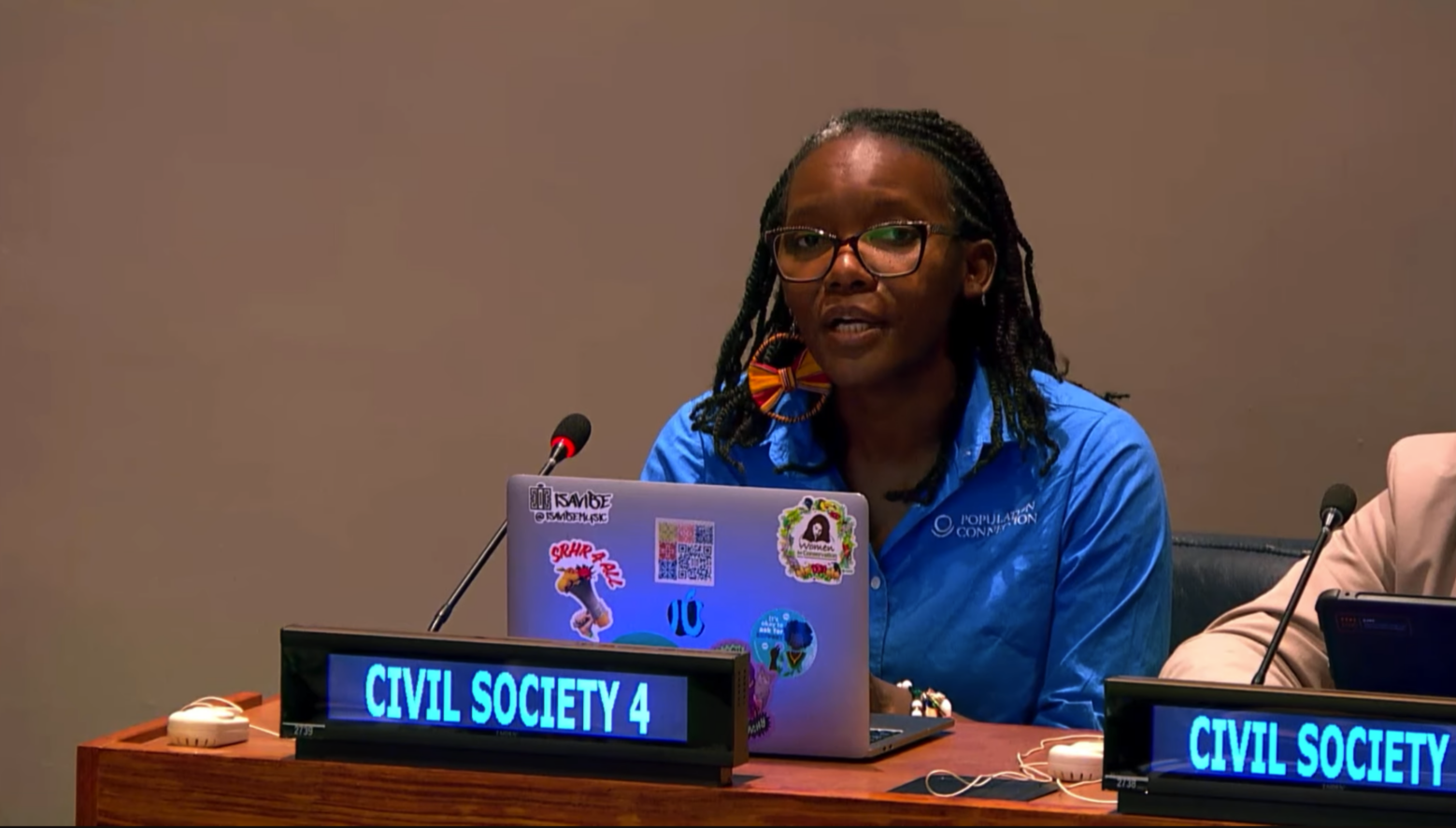
Florence Blondel, Digital Media Manager, delivers our oral statement at the United Nations 59th Session of the Commission on Population and Development (CPD59) on April 15, 2026
Evidence over fear: Reclaiming the population debate at CPD59
Written by Florence Blondel |
Published: April 25, 2026
We also hosted an official side event, focused on the role of demographic and contraceptive research, technology, and education in advancing sustainable population dynamics.
This year’s CPD
The yearly CPD sessions play a pivotal role in advancing the International Conference on Population and Development (ICPD) Programme of Action—a visionary framework for rights-based population action adopted over 30 years ago in Cairo.
This year, delegates gathered at the UN Headquarters in New York City from April 13 to 17 under the theme “Population, technology and research in the context of sustainable development.” We used our statements and interventions to push back against rising pronatalist rhetoric, highlight the urgency of investing in data and family planning, and reaffirm that aging is not a crisis, but a sign of progress.
“This year’s theme marks a real shift from previous sessions. Having attended CPD regularly since 2010, I see it as forward-looking and long overdue. It moves us beyond simply counting people to understanding who they are, where they live, and the realities shaping their lives. It also highlights the critical role of technology and research in generating the data we need. That’s what enables us to respond effectively—meeting people’s needs and improving lives and well-being.”
– Margaret Edison, former Director, National Population Commission (Nigeria)
No consensus
This year’s session ultimately came to a disappointing close, as the Commission once again failed to reach consensus due to resistance from delegations hostile to sexual and reproductive health and rights (SRHR), including embarrassingly, the United States. No outcome document was adopted, despite the importance of the issues under discussion.
The US doubled down on a pronatalist, “pro-family” agenda, framing declining fertility as a crisis while sidestepping reproductive rights. From rejecting the Sustainable Development Goals (SDGs) at last year’s CPD58, to reframing population policy around “family values,” the shift is becoming increasingly clear.
As one US representative stated:
“The family is the foundational unit of society… We’re committed to advancing policies where marriage is celebrated and parents are empowered.”
This position was echoed by a small group of NGOs that attempted to misrepresent what sexual and reproductive health and rights stand for. That rhetoric did not go unchallenged—it was firmly called out on the floor.
But beyond the rhetoric and political positioning, the lived realities discussed throughout the week tell a very different story.
Taking the floor
In partnership with the Population Institute, we delivered an oral statement calling for stronger investment in data systems and family planning research—both essential to evidence-based policymaking.
We also intervened (the UN term for being invited to speak during an official discussion) during the Expert Panel on the programme of work in population, where we underscored three key points: aging reflects progress, rights-based approaches must remain central, and fear-driven pronatalist policies are the wrong response to demographic change.
Finally, we drew attention to a critical gap that continues to undermine sustainable development efforts: the persistent neglect by policymakers and major health and development funders of the links between population dynamics and sustainability.
Aging? Where? “We are not a victim of aging”
Interview with Dr. Abla Alalfy from Egypt at CPD59
We also heard a different perspective on aging from some delegations, including Egypt, during a side interview with Dr. Abla Alalfy, the Deputy Minister of Health and Population for Population and Family Development, and Chair of the National Population Council, who pushed back against growing global anxiety around low fertility:
“Egypt is not a victim of aging and will not be for the next 20 to 30 years. Egypt has a real opportunity to avoid rapid aging. By maintaining fertility around replacement level and focusing on quality not just numbers, we are managing population change more gradually and sustainably.”
Technology is good, but…
While acknowledging the vital role technology plays in climate resilience and sustainable development, the United Nations Department of Economic and Social Affairs (UNDESA) was clear about its limitations.
As Under-Secretary-General Li Junhua noted:
“In some cases, it has exacerbated inequalities and created new divides and challenges.”
Bjørg Sandkjær, Assistant Secretary-General for Policy Coordination, UN DESA, highlighted the growing environmental cost of digital systems:
“The environmental footprint of digital infrastructure, including high energy consumption and electronic waste, poses challenges for sustainability.”
“Achieving sustainability and combating climate change require strategic investments to decouple population increase and economic growth from environmental damage… through circular economy principles that improve efficiency, increase recycling, and reduce waste.”
The world’s youngest grandmother? A window into demographic realities
Population experts shared national, regional, and personal perspectives, grounding global discussions in lived realities. For Uganda, and much of Africa, the challenges are both familiar and urgent.
Mugendawala highlighted three key issues, beginning with sustained high population growth:
“Our population is growing at a faster rate than the continental average. Over the past 50 years, growth has remained around 3% annually, meaning the population doubles roughly every 23 years.”
Uganda delegation at CPD59
This growth, he explained, is driven in part by a still-high though declining total fertility rate, partly sustained by early childbearing among adolescent girls.
He then shared a striking example that underscores the reality behind the data:
“Currently, we may have the youngest grandmother in the world—just 26 years old. She conceived at 13, and so did her daughter.”
The implications are profound:
“Early childbearing has significant negative consequences for girls’ education, maternal and child health, and the economy, as it increases dependency burdens and entrenches poverty.”
Importantly, these challenges are not unique to Africa. A delegate from Haiti, Marc Henry Pierre-François, echoed similar concerns:
“Early pregnancy among adolescents remains high. This has significant impacts on health, education, and development, and is linked to insufficient access to family planning, sex education, and youth-adapted services.”
It’s worse in the Philippines according to Dr. Lisa Grace Bersales, Head of the Commission on Population and Development of the Philippines:
“Our adolescent pregnancy for 15 to 19 has been decreasing through the years. The worrying trend is increasing pregnancies of below-15-year-olds.”
CPD59 event: Ghana & the Pan-African Intergovernmental Agency for Water & Sanitation for Africa
Across sessions, a broader picture emerged, one that puts these national realities within continental trends. At a side event hosted by Ghana and the Pan-African Intergovernmental Agency for Water and Sanitation for Africa, the message was clear:
“Across Africa, demographic realities are shifting rapidly. The population is projected to double by 2050, with young people representing the majority. This presents immense opportunity, but also intensifies pressure on water resources, sanitation systems, health services, and infrastructure.
“Ensuring that essential services expand at the same rate as population growth remains critical, particularly in rural and peri-urban areas where gaps are widest.”
– Dr. Nabhit Kapur, Permanent Observer of the Pan-African Intergovernmental Agency on Water and Sanitation for Africa (WSA)
These are lived realities. And without sustained investment in data, family planning, and rights-based approaches, they will continue to deepen inequality rather than drive development. Yet at the very moment when better data is most needed to understand and respond to these challenges, one of the world’s most critical sources of demographic and health data is being lost.
The loss of DHS data
UN DESA DHS side event
A standout side event organized by UN DESA and the Inter-Secretariat Working Group on Household Surveys (ISWGHS) focused on the loss of the Demographic and Health Surveys (DHS)—one of the most comprehensive sources of demographic data globally, which has suffered from the Trump administration’s funding cuts. This is an issue we had also raised in our oral statement.
“The termination of core funding for the Demographic and Health Surveys program is a major shock to the global demographic and health data system, creating uncertainty for future data availability—especially for already vulnerable populations.”
– Vladimira Kantorová, Chief, Fertility and Population Ageing Section, UN Population Division
UN DESA has long relied on DHS data for its demographic estimates and projections, including the authoritative World Population Prospects. As highlighted during the session:
“The survey has been the most comprehensive data source on contraceptive use and needs, as well as reproductive decision-making… representing key SDG indicators on family planning.
“The loss of the DHS will most severely limit data available for core demographic and family planning indicators in sub-Saharan Africa, Central and Southern Asia, and least-developed countries.”
– Joseph Molitoris, Population Affairs Officer, UN Population Division
Critically, the impact will fall hardest on already vulnerable groups—children, people living in poverty, adolescent girls, and young women.
We also spoke with Margaret Edison, former Director of Nigeria’s National Population Commission and friend to Population Connection, who emphasized what this loss could mean for countries like Nigeria:
“In sub-Saharan Africa, where censuses have been irregular, DHS has been the primary source of demographic data. Without it, countries risk losing the evidence needed to plan and respond effectively. We risk losing the evidence needed to make informed decisions.”
Our CPD59 side event: Research, technology, and education for sustainable population dynamics
As part of CPD59, we hosted an official side event exploring how gaps in demographic and contraceptive research are undermining progress on sustainable development.
The session, led by Population Connection board member Robert Engelman, emphasized the importance of closing knowledge gaps among policymakers and journalists, and strengthening education on demographic trends and barriers to contraceptive use.
“Funding for this kind of research is vulnerable and, in some cases, actively being cut. That includes federal efforts to reduce support for research and public health programs.”
– Robert Engelman, author, former journalist, Population Institute Senior Fellow
The risk of setbacks at CPD59
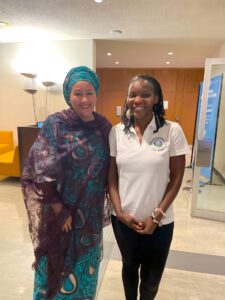
Florence with Amina Mohammed, UN Deputy Secretary-General
Amina Mohammed, the UN Deputy Secretary-General, underscored a key contradiction: at a moment of rapid technological and demographic change, investment in population research is declining.
“Rolling back investment in population research now would be a serious setback for the SDGs and all the people the goals are meant to serve.”
In her remarks, she called for scaled-up financing both domestic and international, aligned with national priorities:
“Because evidence without investment cannot deliver impact.”
There is no doubt from discussions at CPD59 that population aging, sexual and reproductive health, international migration, and urbanization will all be profoundly shaped by technology. The question is whether evidence, rights, and lived realities will remain at the center of global population policy.
If we are serious about sustainable development, we must recommit to what works, investing in data, strengthening family planning, and centering rights-based approaches. Anything less risks not only slowing progress but reversing it. Population Connection took the floor at CPD59 this year to make that case. The work now is to ensure it is not only heard but acted upon.
From left to right: UN Population Division Director John Wilmoth, who is retiring; Li Junhua, Under-Secretary-General for Economic and Social Affairs; UNFPA Executive Director Dr. Diene Keita; and CPD59 Chair, Zéphyrin Maniratanga
Are we awakening from the infinite growth delusion?
Those familiar with Population Connection’s work know we have been highlighting the folly of pursuing infinite growth on a finite planet since 1968. Fortunately, a rising “postgrowth” movement is rekindling…
New report: Young people still value partnership and parenthood, but many feel these are unreachable
For decades, declining global fertility rates have often been explained by the assumption that young people simply don’t want to marry or have children. The newly released report from the…