Our World in Data (OWID) recently launched an interesting new tool that allows users to see how changes in fertility rates, life expectancy, and migration rates affect national and global population trajectories up to the end of the century. Here, we play with some global scenarios to see how much of a difference modifying the fertility rate could make.
The tool
Using data from the UN World Population Prospects — the most authoritative demographic estimates and projections — the new OWID tool provides a simple model with three variable inputs: total fertility rate (the average number of live births per woman), life expectancy, and net migration rate. These can be modified at three points in time: 2030, 2050, and 2100.
The output shows how these modifications affect the population curve and the demographic age structure in 2100 for the country of choice.
OWID explains that they tested their model’s accuracy by running it with the UN’s own assumptions for fertility, life expectancy, and net migration, and then comparing the resulting projections. They found that across 237 countries and territories, the mean difference between their model’s projections for 2100 and those of the more complex UN model was 5.1%, and the median difference was 2.4%. Nearly 80% of countries and territories fell within 5% of the UN projection, and 90% came within 10%.
OWID argues,
“The fact that our simplified model closely replicates the UN’s results in most countries is a strong validation of the approach.”
How much can average family size affect future population size?
At Population Connection, we are most interested in how lower fertility rates (achieved by empowering women and girls) can bring about a more sustainable population size at the global level, so we selected “World” as the country and did not modify longevity.
The current median UN projection is that the global total fertility rate (estimated at 2.23 today) will reach 2.2 in 2030, 2.1 (the replacement rate) in 2050, and 1.8 in 2100, while average life expectancy will reach 74 in 2030, 76 in 2050, and 81 in 2100.
This translates to a projected population size of 8.6 billion in 2030, 9.7 billion in 2050, and 10.3 billion in 2100. Now let’s see what would happen if we change the fertility rate at different points in time.
1) Lower fertility in 2050
As we are less than four years away from 2030, and in light of the US government’s massive cuts to international family planning funding (in absolute terms, the US had been by far the largest donor for decades) and to foreign aid in general, it is pretty unlikely that we can significantly accelerate fertility decline by then, so we will leave 2030 as it is.
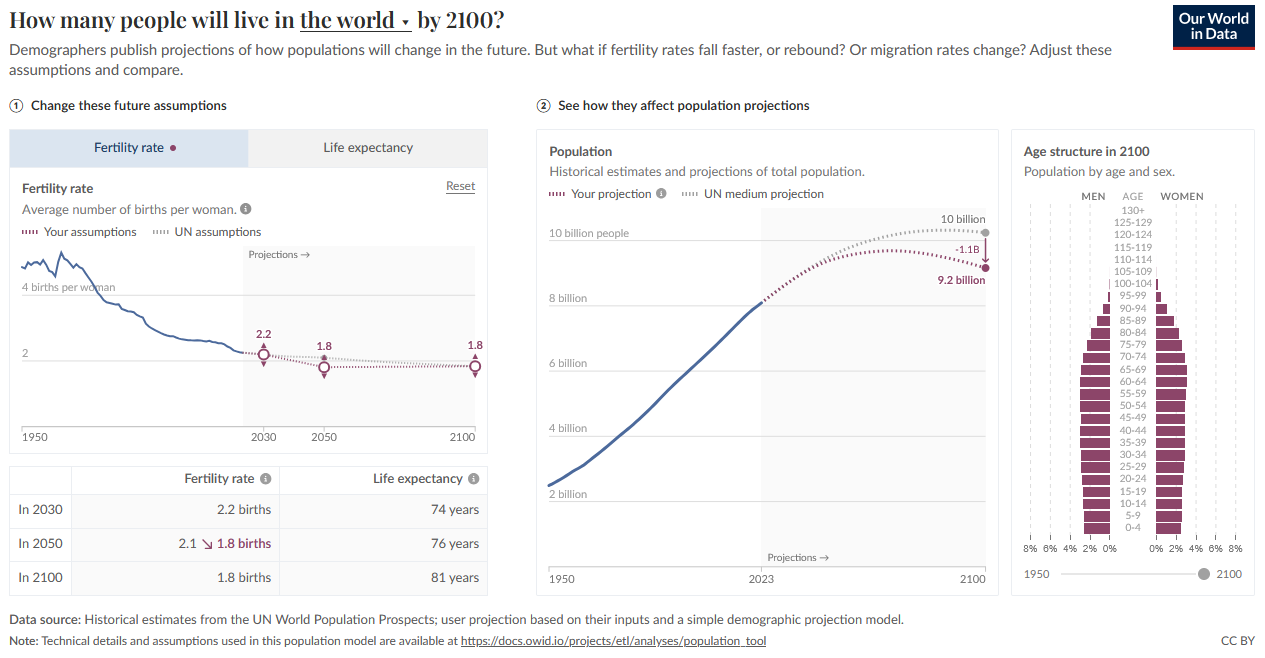
Let’s assume, however, that the world fertility rate declines faster between 2030 and 2050 than the UN predicts. If we set the 2050 fertility rate to 1.8 instead of 2.1, we’d get 9.5 billion people in 2050 and our population would never quite reach 10 billion. We would approach the end of the century with 9.3 billion people. While this is still quite a lot higher than most estimates for a sustainable population size, one billion fewer people than we are currently headed towards would undoubtedly give us a better chance of averting catastrophic environmental outcomes.
2) Lower fertility in 2050 and 2100
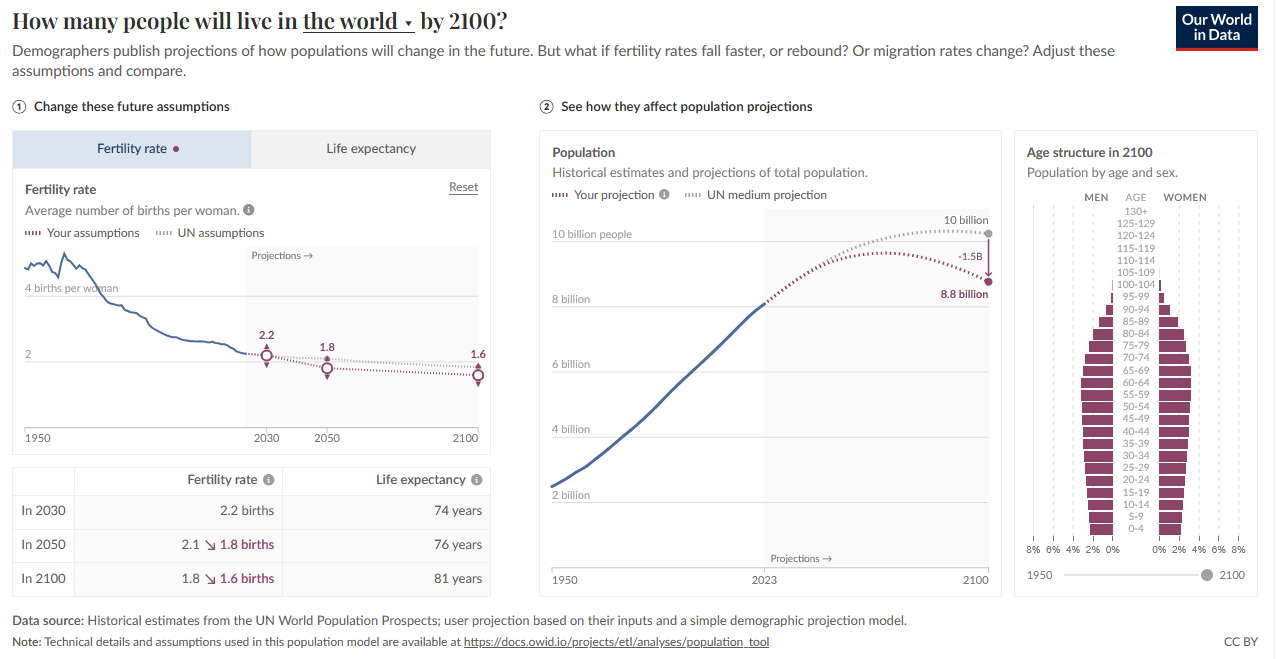
It’s not that unlikely that the global fertility rate will drop lower than 1.8, assuming continued progress towards women’s empowerment and expansion of the new small family norm, as this has already happened in almost all wealthy nations. So, let’s say that after reaching 1.8 in 2050, fertility will continue to decline to 1.6 — the United States’ current rate — by the end of the century.
This would yield a population size of 8.8 billion in 2100. Still higher than today’s 8.3 billion, but a lot more manageable than 10.3 billion.
3) Much lower fertility in 2100
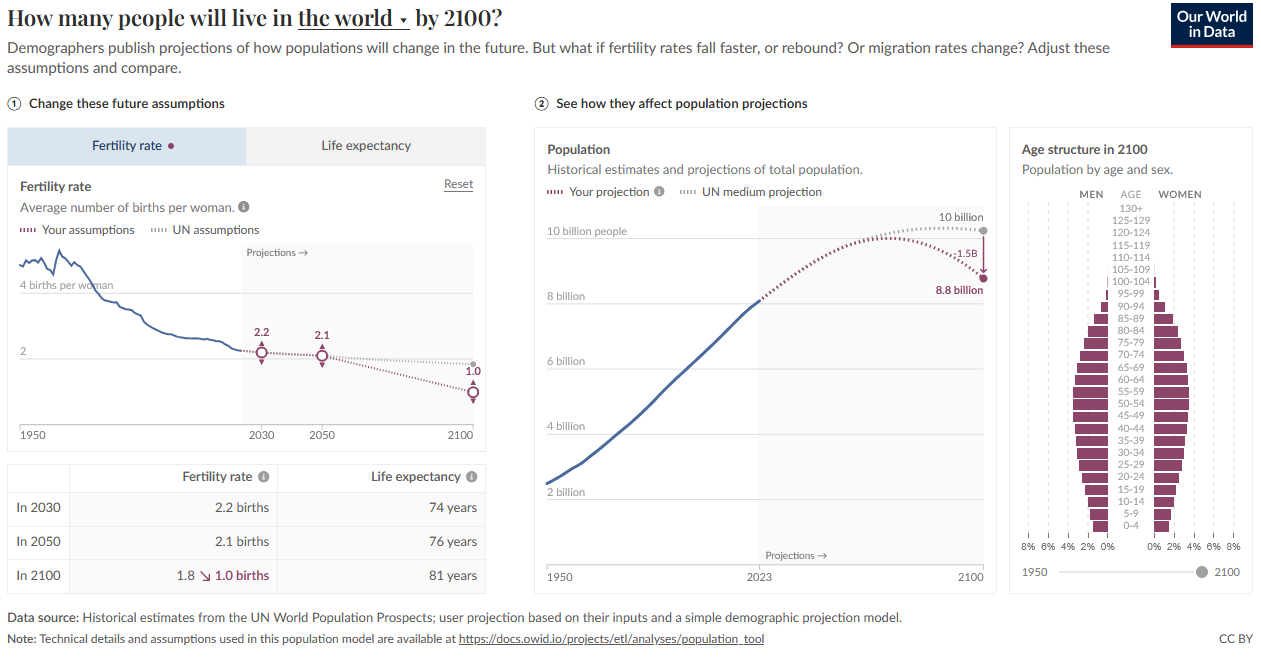
Let’s assume only the 2100 fertility rate will be lower than what the UN projects. Instead of fertility converging at 1.8, what would happen if women in 2100 would have only one child on average? In fact, this drastic drop would still lead to a 2100 population size that is larger than today’s, at 8.8 billion.
This demonstrates that when it comes to future population sizes, early intervention is key. The sooner we increase efforts to advance gender equality and remove barriers to family planning and girls’ education, the better our chances of achieving a sustainable population size within a reasonable time frame.
4) Higher fertility
We’ve explored fertility decline pathways, but what would happen if fertility rates were higher than what the UN projects? This is sadly not an unreasonable assumption and could easily come true if foreign aid cuts are sustained.
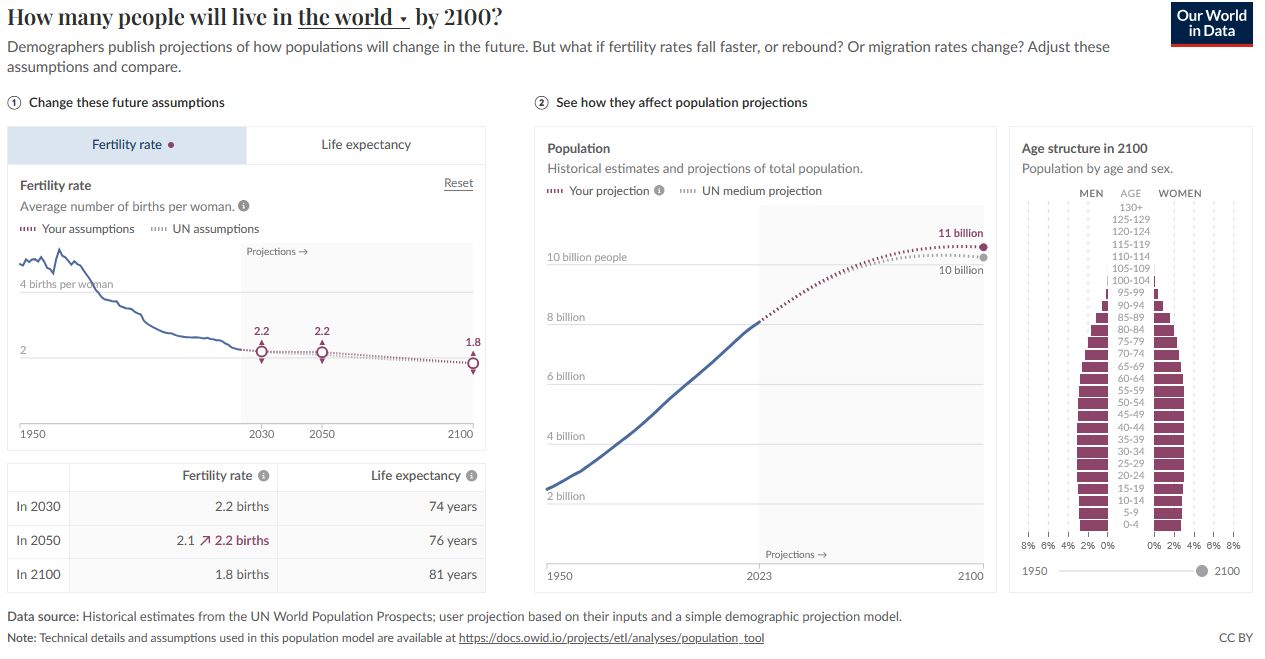
If governments fail to increase funding for empowering population solutions by 2050, leading to continued high rates of teen and unplanned pregnancy as well as forced birth, we will likely see a higher fertility rate in 2050 than projected. Let’s assume the best of the worst-case scenario, and that there is no change between 2030 and 2050, so the global fertility rate stays at 2.2 instead of declining to 2.1. This seems like a very minor change, but would actually put us on a path to exceed 11 billion by 2100. Of course, more substantial fertility increases by 2050 would result in an even higher population — for example, a rate of 2.4 could lead to 12 billion in 2100, and no peak this century.
5) “Ultra-low” fertility
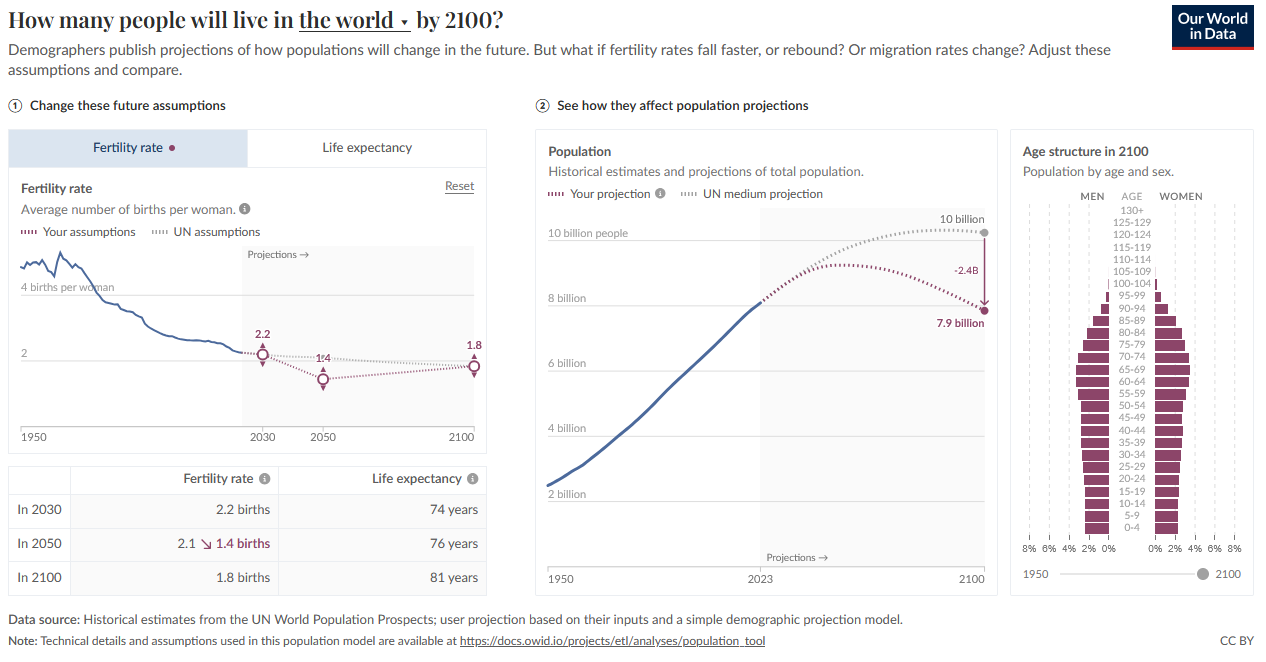
Just over 40 countries and territories now have “ultra-low” fertility rates, meaning they are below 1.4 births per woman. Surveys reveal that most people want two kids, so we can assume that a reduction in the world fertility rate to this level would likely not entirely be driven by choice (see here for a summary of the reasons people state for having fewer than their desired number of children). With our worsening interlinked socio-environmental crises and growing concern over the state of the world, perhaps we could be on track to such a low level by 2050 (assuming most women would have reproductive autonomy by then).
If the total fertility rate plummeted to 1.4 in 2050 and crept back up to the UN assumption of 1.8 by the end of the century, our population size in 2100 would be 7.9 billion — smaller than today’s. If fertility stayed at 1.4 until 2100, the resulting population would be just 7.3 billion — three billion fewer people than what the UN’s median projection forecasts.
What can we learn from this tool?
While no model can be 100% accurate, as they all use researchers’ assumptions about future human behavior, and these scenarios are mostly illustrative, they demonstrate two important facts:
Fact 1: It’s foolish to fear or fight declining birthrates
Pundits, politicians, and economists across the Global North are fretting over low fertility rates, framing these as a “crisis” due to their potential impacts on economic growth and growth-dependent pension systems. Prominent pronatalists like Elon Musk are even fearmongering about small family-driven “population collapse.” This is clearly absurd. The OWID population tool suggests that even significantly faster and larger fertility decline than is currently projected would not lead to a major population decrease this century.
Barring global disasters, it is improbable that anybody alive today will see a smaller world population than today’s. Regarding the socio-economic challenges imposed by population aging and decline, these are manageable with available policy levers.
Of course, sustained low fertility would eventually lead to a considerably smaller population in the distant future, but it’s incredibly difficult to make reliable projections past 2100, and it seems unlikely that humanity would stop breeding to the point of extinction.
At current population and consumption rates, we are already in deep ecological overshoot, using up natural resources almost twice as fast as they can regenerate, and having breached seven out of nine critical planetary boundaries. A smaller population size is deeply desirable. As our impact on the environment is a product of how many of us there are and how much each of us consumes, stabilizing our population at a lower level will give us a far better shot at solving our environmental crises, and at enabling a decent standard of living for all within Earth’s limits. This is especially relevant as large parts of the world still have high poverty rates —people in these regions have every right to increase their consumption. Of course, ending excessive consumption in rich countries is also critical.
Fact 2: Timely intervention is key
Another important lesson we can learn from this tool is that the sooner we ramp up empowering population solutions, the bigger the impact on our population trajectory this century.
The tool demonstrates that failure to make significant progress on gender equality and reproductive health and rights within the next few decades would ensure our population exceeds 10 billion by century’s end. Conversely, accelerating fertility decline through investments in international family planning and women’s rights could put us on a path towards a population size that is smaller than today’s clearly unsustainable 8.3 billion.
Your turn
Here we presented just a small handful of the scenarios the OWID population tool can produce. The possibilities are endless! Over to you — see for yourself how even very small changes in some of the variables that go into population models can drastically affect future outcomes.