

Reflecting on Paul Ehrlich’s legacy
Our team at Population Connection is saddened by the passing of our co-founder and distinguished scientist, Dr. Paul R. Ehrlich, on March 13 at the age of 93. Population Connection,…
Read More
Written by Olivia Nater | Published: March 27, 2026
Dr. Paul Ehrlich, one of Population Connection’s founders and instigator of the population movement, died on March 13, 2026. You can read our statement and blog post reflecting on his legacy. This article discusses the media response to Dr. Ehrlich’s passing.
 Paul Ehrlich, the author of the 1968 bestseller The Population Bomb (co-written with his wife, Anne Ehrlich), was a highly respected scientist as well as a controversial public figure —this latter aspect is where the vast majority of media stories about his passing placed their focus.
The Population Bomb (which came to define Ehrlich’s career despite the dozens of other books and more than 1,000 scientific papers he contributed to) regrettably promoted coercive population control if voluntary methods to curb population growth failed (which he believed they would). Some critics claim that Ehrlich’s views inspired draconian population control programs, such as India’s forced sterilization campaign and China’s one-child policy. Whether true or not, the book’s openness to considering coercion (which, to our knowledge, Ehrlich didn’t publicly denounce in later life) certainly deserves criticism.
Surprisingly, this valid reproach is not the primary reason that so many media articles condemned Ehrlich. They mostly focused on The Population Bomb’s unfortunate scenarios of continued population growth leading to mass starvation. Unable to foresee the magnitude of success that the Green Revolution would have in the near future, Ehrlich warned that population growth would soon outstrip available food supplies and that “hundreds of millions of people” would starve to death in the 1970s. While several million people have died of famine since the late 1960s, the death toll was nowhere near what Ehrlich predicted, because of the dramatic increase in crop productivity brought about by modern agriculture.
Fixating on the fact that Ehrlich’s mass mortality scenarios did not pan out as he predicted, and because he famously lost a bet to cornucopianist* Julian Simon about the cost of raw materials, media outlets concluded that Paul Ehrlich “was wrong about everything,” while neglecting that his warnings about environmental devastation, natural resource shortage and conflicts, pandemics, and the growing risk of nuclear war were actually pretty spot-on.
*Cornucopianism, or techno-optimism, is a philosophy that assumes humanity’s potential to innovate can overcome all risk of resource scarcity and enable infinite growth. Adherents of cornucopianism also tend to believe that the larger the population, the greater its innovation potential.
Ehrlich’s mistake (aside from the obvious ones discussed above) was believing that the cost of ecological overshoot would be paid in human lives within just a decade of the publication of his book. What really happened, however, is that through the Green Revolution, the price of sustaining our huge and rapidly growing population was carved out of our natural environment. Modern agriculture is a leading driver of our environmental crises, from climate change, to biodiversity loss, deforestation, water shortage, and pollution.
Every few years, humanity breaches more critical planetary boundaries — we have now exceeded the safe zone for seven of the nine vital processes that sustain life on Earth. Our huge and growing population, combined with increasing consumption levels, lies at the root of this dangerous transgression.
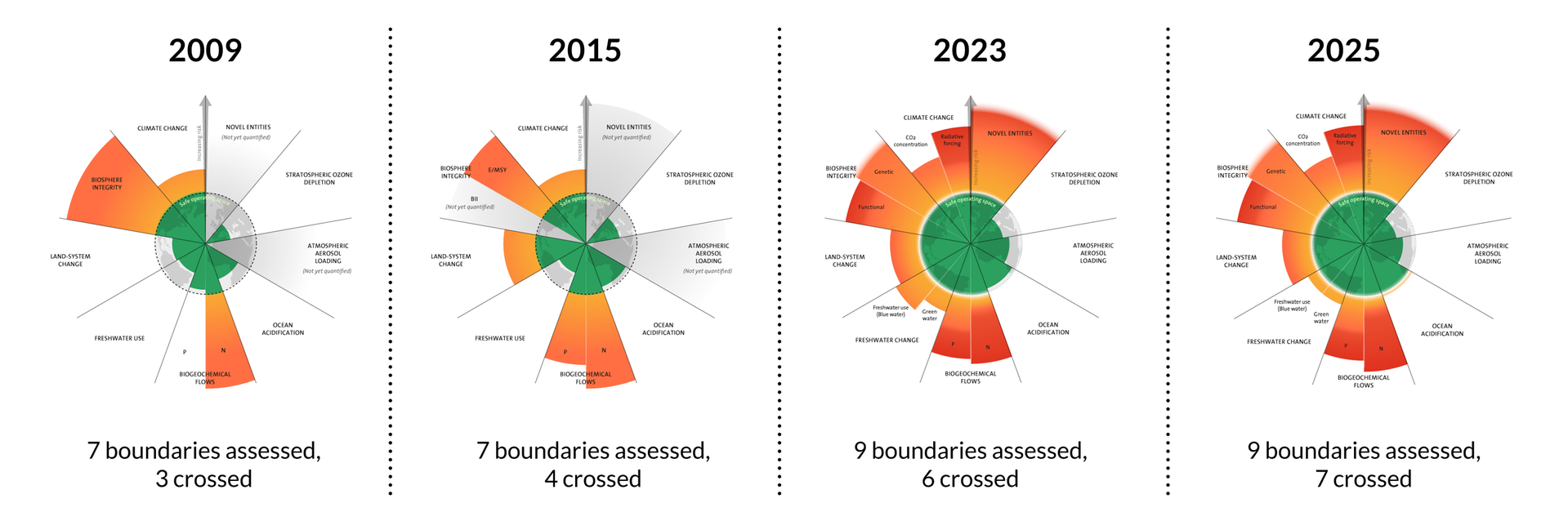
Astonishingly, the media response to Ehrlich’s passing largely ignored the environmental impacts of population growth, and argued that his unrealized mass starvation predictions prove that the very concept of planetary limits is wrong.
The Washington Post’s Editorial Board wrote that Ehrlich’s work “distracted many from the significant challenges that humanity does face. Climate change, pollution, disease, poverty, state failure and war are real problems that humans are working to alleviate.” They clearly didn’t study Ehrlich’s work, because he wrote about all these issues. The Post’s commentary was one of many media articles on Ehrlich’s death that leaned heavily into cornucopianism/techno-optimism.
In a posthumous podcast episode about Paul Ehrlich, the BBC interviewed Darrell Bricker, co-author of Empty Planet: The Shock of Global Population Decline, a book that raises alarm over potential future population decline driven by low birthrates. In its coverage of Ehrlich’s passing, PRX’s radio program The World featured Michael Geruso, an economist and co-author of After the Spike: The Risks of Global Depopulation and the Case for People, another book that argues that larger populations are better. These odd interviewee choices are like platforming a climate skeptic to mark the death of a famous climate scientist.
The Washington Post editorial bizarrely laments the lives of people who were never even conceived: “Snuffing out lives before they get started means snuffing out unknown potential to make the world a better place.” This reveals the Editorial Board’s penchant for a trendy cornucopianism-adjacent philosophical belief called longtermism, an offshoot of a form of quantitative utilitarianism called Effective Altrusim. Longtermism is espoused by problematic billionaires like Elon Musk and Peter Thiel (and, presumably, The Post’s owner, Jeff Bezos). Longtermists argue that maximizing humanity’s potential in the distant future matters more than alleviating current suffering. They believe that individual people’s happiness scores add up to “collective happiness,” and therefore conclude that a very large population of moderately happy (or even unhappy) people is more desirable than a small population of very happy people.
Cornucopianism, longtermism, and the “growthism” they preach have infiltrated main-stream thinking, presumably because of the ridiculous wealth of some of their proponents and because these ideologies appeal to those interested in preserving the status quo. It is much more comfortable to continue on with our growth-dependent, extractivist behavior and hope that technology will save us, than to pursue the radical systemic change promoted by those who believe in planetary limits.
Of course, just like our co-founder, Population Connection opposes the absurd notion that infinite population and economic growth are both possible and desirable. The escalating, intertwined socio-environmental crises we are living through today are clear symptoms of humanity’s failure to respect Earth’s limits, and thousands of scientists agree that if we continue on this course, we may well end up facing the catastrophic mass mortality that Ehrlich, the boy who cried wolf, foretold after all.
One thing we can learn from the reaction to Ehrlich’s death is that too much negativity and doom-saying are counterproductive. Ehrlich was not one to mince words, and his tendency to make exaggerated and extremely dark predictions unfortunately came to define his legacy, instead of his many valuable contributions to science and environmentalism.
Perhaps today’s public perception of Paul Ehrlich indicates that instead of focusing too much on how humanity is currently paving the way towards collapse, environmentalists should highlight the wonderful futures we could facilitate if we rally together and transform our societies and economies so that people and nature are valued above profit.
Were you surprised by the reaction to Paul Ehrlich’s death? What stood out to you, and what lessons do you think we can learn from this? Let me know by email at onater@popconnect.org.