
FlowReady: Before the Blood – Presented by Florence Blondel, Margret Kagoya, Lea Bwanika Owino, and Rukia Nakamatte
“For FlowReady, menstrual health is just the starting point—we’re working to keep girls in school, prevent early marriage, and support the agency and opportunities that shape their futures.”
In Eastern Uganda, menstrual health is often addressed too late—after girls have already experienced confusion, stigma, and disruption to their education.
For many girls, the first period is still seen as a signal that they are ready for marriage and childbearing, putting their health, education, and futures at risk.
One of our newest Global Partners, FlowReady, is working to change this story by equipping girls with knowledge, confidence, and support before they reach menarche, while engaging parents, teachers, and community leaders to shift harmful norms.
In this session, public health experts and communications specialists shared:
FlowReady: Before the Blood – Presented by Florence Blondel, Margret Kagoya, Lea Bwanika Owino, and Rukia Nakamatte
 Florence Blondel, Founder, FlowReady
Florence Blondel is a population and development specialist with a background in journalism and global advocacy. She founded FlowReady to ensure girls are prepared, supported, and empowered before their first period—turning her own difficult experience into a mission for systemic change. She leads FlowReady’s strategy, partnerships, and program development, focusing on improving menstrual education, tackling stigma, and challenging harmful norms that link menarche to early marriage and childbearing. Florence has over a decade of experience working at the intersection of population, health, and the environment. She has contributed to global initiatives through organizations including Population Matters and Global Footprint Network and has represented key advocacy issues at international platforms such as the United Nations Commission on Population and Development.
An award-winning journalist, she began her career in 2010 with media outlets in Kenya and Uganda, helping bring underreported issues—such as menstruation—into public conversation. She holds an MSc in Population and Development from the London School of Economics and Political Science (LSE) and currently serves as Digital Media Manager at Population Connection. Fun fact: Florence was among the first journalists at NTV Uganda to produce a feature on menstruation—an early sign of the work she leads today. She won’t stop talking about periods. Period.
 Lea Bwanika Owino, Country Director/ Program Lead, FlowReady
Lea Bwanika Owino a behavioral change and strategic communications specialist who leads FlowReady’s work in Uganda. She oversees on-the-ground implementation, partnerships, and community engagement, ensuring that girls receive accurate, timely education before their first period. With over ten years of experience, Lea specializes in designing and delivering behavior change communication strategies across health and development sectors. Her work focuses on breaking stigma, challenging harmful myths, and supporting informed decision-making among young people and communities. Lea has led multiple large-scale campaigns supported by UKAID, USAID, Stop Malaria, UNFPA, and the Ministry of Health Uganda. She has successfully planned, developed, implemented, and managed creative designs and content for social media campaigns such as “GENEXT,” a campaign to promote smaller families and empower young people about their life choices, and “If it’s not safe, it’s not safe,” a campaign to support youth in making informed decisions about their sexual and reproductive health. Fun fact: On a good day, Lea won’t leave the dance floor the same.
 Kagoya Margret, Health Expert, FlowReady
Kagoya Margret is a Registered Nurse with over 10 years of experience in maternal and adolescent health. She is passionate about menstrual health education and has been instrumental in supporting FlowReady as a health expert. Margret is currently advancing her anesthesia skills to further strengthen safe motherhood care in Mayuge District, Uganda.
 Rukia Nakamatte, Public Health Communication Specialist, Uganda Ministry of Health
Rukia is an experienced Public Health Communication Specialist with a wealth of knowledge in disease prevention, social and behavior change communication, project management, and health policy advocacy. She has considerable experience in developing health programs, co-coordinating and implementing partnerships, and enacting health programs aimed at uplifting the health of underprivileged and marginalized communities. She is currently a Technical Assistant at the Ministry of Health in Uganda, in the National Malaria Control Division.
Q&A
Questions from the audience with responses from Florence Blondel, FlowReady Founder
What are the most significant forces/groups in Uganda perpetuating this situation and other forms of patriarchy?
There is no single group or force responsible. Menstrual stigma is sustained by a combination of poverty, silence around sexuality, gender norms, school and sanitation gaps, weak policy implementation, and household power dynamics.
In many communities, menstruation is still treated as a private “women’s issue,” which means fathers, boys, male teachers, and community leaders are often excluded from the conversation. That exclusion reinforces shame. At the same time, poverty makes the issue worse: even when families understand the need for menstrual products, they may still prioritize food, school fees, or other essentials. FlowReady’s approach is to work with girls, boys, parents, teachers, health workers, local leaders, and media because menstrual stigma is social — so the solution must also be social.
What did local groups use historically, pre-colonialism, pre-urbanization? Does the large, long-standing body of anthro research provide any help with this? Can old methods be adapted to current situations? Sanitation structures in modern societies are a huge issue, and affect girls, as your data shows. So where to start!
This is a valuable question, and one we would love to explore more deeply with anthropologists and historians. Historically, women and girls in many communities used locally available materials such as cloth, plant fibers, skins, and other absorbent materials, depending on geography, livelihoods, and cultural practices.
However, we would be cautious about romanticizing older methods. Some may have been practical in their context, but today’s realities are different: girls are expected to sit in classrooms for long hours, use school latrines, travel longer distances, and manage menstruation in more crowded or less private environments.
Anthropological research can absolutely help by showing that menstrual beliefs are not fixed or universal. It can also help us distinguish between harmful stigma and potentially useful community knowledge. But any adaptation today must prioritize safety, dignity, school participation, hygiene, and girls’ own preferences.
Is menstrual education (and other sexuality information generally) provided in elementary school to girls and/or to boys?
Uganda has a National Sexuality Education Framework, launched by the Ministry of Education and Sports in 2018, which provides guidance for age-appropriate sexuality education in formal schools. UNFPA described it as Uganda’s first national guideline for sexuality education in formal education settings.
In practice, however, implementation varies widely. Some schools cover menstruation, puberty, hygiene, and life skills, but the depth and comfort level depend heavily on the school, teachers, resources, and community attitudes. This is exactly why FlowReady works in schools and includes both girls and boys — because many children still reach puberty with incomplete or incorrect information.
What approximate percentage of elementary school teachers are female?
The most recent figure I found quickly is older: World Bank/UIS data reported that about 42.7% of Uganda’s primary teachers were female in 2016. I would avoid presenting that as current without checking the latest Ministry of Education statistics.
The broader point is that many girls are still taught by male teachers or attend schools where female mentorship is limited. That makes it important to train both female and male teachers to support menstrual health with sensitivity.
Regarding mass media. You mention newspapers, radio, and TV. But isn’t “social media” fairly widespread and significant, even in rural areas? Where does that fit?
Social media is growing in Uganda and is important, especially for younger and urban audiences. But access remains uneven. DataReportal estimated internet penetration in Uganda at about 27% in early 2024 and social media users at about 5.3% of the population. Uganda’s own WSIS progress report also notes persistent rural internet gaps, electricity barriers, smartphone affordability issues, and gender disparities in digital access. Only one-fourth of men (25%) and women (15%) use the Internet (UDHS 2022). Internet use is more common in urban areas (31% of women and 46% of men) than in rural areas (7% of women and 17% of men). Approximately 76% of Ugandans live in rural areas, where high poverty levels act as a direct structural barrier to internet access and social media usage.
So for FlowReady, social media is useful for visibility, advocacy, and reaching connected audiences, but radio remains especially powerful for rural communities because it reaches parents, fathers, teachers, and listeners who may not have smartphones or reliable internet.
Is sex education and pregnancy prevention being taught, and how is access to contraceptives?
Uganda has a National Sexuality Education Framework and adolescent health policies, but implementation is uneven and often sensitive. Some sexuality education is delivered through schools, health facilities, youth programs, and community organizations, but the content and comfort level vary.
Contraceptives available in Uganda include condoms, pills, injectables, implants, IUDs, emergency contraception, and permanent methods for adults. “Knowledge of contraceptive methods is nearly universal in Uganda, with 99% of both women and men having heard of at least one method of contraception.” (UDH2022)
Access can vary by location, age, provider attitudes, stock availability, cost, and social stigma. Studies continue to show that unmet need and adolescent pregnancy remain significant challenges despite family planning efforts.
FlowReady does not provide contraception. Our focus is on menstrual health education and preparing girls before menarche. But we recognize that menstrual health sits within a broader adolescent health and reproductive health context.
How can we help with funding menstrual products for girls in Uganda? Does Population Connection help with that? Any government agencies?
Supporters can donate directly to FlowReady through our website. A FlowReady kit costs about $7.50 per girl and includes reusable pads and basic menstrual health supplies designed to support girls for more than two years.
Population Connection has supported FlowReady as a Global Partner and helped amplify our work to new audiences. Government policy in Uganda recognizes menstrual health as important, and the Ministry of Education issued school guidance on menstrual hygiene management, including private toilets, water and soap, and emergency supplies. However, implementation and resourcing remain uneven, which is why community organizations still play such an important role.
Are these government policies recent? Have they been tried in the past?
Uganda’s formal menstrual health policy attention has grown over the past decade. The Ministry of Education issued a circular to schools in 2015 on actions to support girls’ menstrual hygiene needs, and menstrual health was later integrated into WASH-in-schools planning frameworks. Uganda also had a Menstrual Hygiene Management Charter in 2015, reflecting government and civil society commitment to the issue.
So, the issue is not completely new. The challenge is implementation: schools may know what should happen, but lack water, soap, private facilities, emergency products, disposal systems, trained teachers, or budgets.
I am here from Women for Conservation! We have a connection with Maasai Girls Initiative in Kenya, which does very, very similar work. Do you ever work with them?
Not yet, but we would be very interested in learning more. FlowReady is currently focused on Uganda, especially Mayuge, and on earlier work in the Luweero districts, but our long-term vision includes expanding across Uganda and East Africa. A connection with Maasai Girls Initiative sounds very aligned, especially because our work overlaps around girls’ education, menstrual health, early marriage prevention, and community engagement. We would welcome an introduction. PS: I love the work Women for Conservation does.
How much of the “shame” associated with menstruation is “traditional” vs. Christianity and Islam influences! Anthropological work suggests that such attitudes were not necessarily characteristic of pre-Christian-Islamic influences.
That’s a fascinating question, and the honest answer is that it’s difficult to separate traditional beliefs from the influences of Christianity, Islam, colonialism, and broader social change because these influences have interacted for generations. In some cases, beliefs about menstruation as shameful, impure, or something to be hidden may have been reinforced by religious teachings, colonial-era social norms, and Victorian attitudes toward sexuality and women’s bodies. At the same time, menstrual restrictions and taboos have existed in many societies around the world, including societies with no Christian or Islamic influence, so there is probably no single explanation. From FlowReady’s perspective, what matters most is not where a particular belief originated, but how it affects girls today. Whether a myth comes from tradition, religion, culture, or misinformation, our goal is to ensure girls receive accurate information, dignity, and support.
It’s astonishing that we are STILL at this long-time issue of menstruation (and broader issue of female bodies/sexuality) in 2026!!! Why do you think this is still the case in Uganda now?? After decades of feminists having tried to de-stigmatize it. Including Ugandan feminists!!
It’s absurd, indeed! I actually see the fact that we’re discussing menstruation publicly today as evidence that progress has occurred. The challenge is that menstrual stigma is tied to broader attitudes about gender, sexuality, and the female body, and those norms often change more slowly than laws, policies, or educational programs. That’s why we believe change must involve entire communities, not just girls. And to be fair, menstrual stigma is not unique to Uganda. We see versions of it around the world, including in high-income countries. IT IS TIRING! PATRIARCHY is hard to get rid of!
Are there other groups you are collaborating with in Uganda (or elsewhere) on this issue?
FlowReady is still a very young organization. We were formally established as a nonprofit in 2025 and received our first major program grant this year through Population Connection’s Global Partners Program. So, while we may not yet have a large network of formal partnerships, collaboration has been central to our approach from the very beginning.
In Uganda, we work closely with schools, senior women and senior men teachers, health workers, district officials, community development officers, village leaders, and local radio stations. For example, our 12-week radio series was made possible through a wonderful partnership with Your Voice FM in Mayuge, alongside district health officials and local experts who generously shared their knowledge with the community.
We also purchase high-quality reusable menstrual pads from AFRIpads, a leading Ugandan social enterprise. Their products are included in our FlowReady kits because we want girls to receive durable, reliable products that can support them for more than two years. While we are currently a customer rather than a formal partner, we would very much welcome opportunities to collaborate in the future.
Internationally, we’re grateful to be a Global Partner of Population Connection, whose support has helped us strengthen our programs and reach new audiences. We’ve also recently completed The Pad Project’s Ambassador Program, which has connected us with menstrual health advocates from around the world.
As a small organization, we don’t see collaboration as optional—it’s essential. Rather than trying to do everything ourselves, we believe the greatest impact comes from working alongside schools, government, health professionals, community-based organizations, and other nonprofits. We are actively building those relationships and are always excited to explore new partnerships.
How have cuts in funding from the US and other donor nations affected your programming or communities?
This is a timely and important question.
Like many organizations working in health, education, and community development, we are operating in an environment where funding uncertainties affect both local organizations and the communities they serve.
FlowReady is still a relatively young organization, so we have not yet experienced the same level of disruption as larger NGOs that depend heavily on international aid. However, we do see the effects in the broader ecosystem. Schools, health facilities, and community organizations often rely on external support, and when funding decreases, vulnerable populations can feel the impact.
One lesson we continue to learn is the importance of local ownership and community partnerships. Sustainable change cannot rely entirely on external funding. Building local capacity and community support is essential.
What is the average age of menarche in Uganda or among the girls FlowReady serves?
The average age of menarche globally is around 12 years, although it can occur earlier or later.
In Uganda, available studies generally report an average age of around 13 years, though it varies by region, nutrition, health status, and individual circumstances.
Among the girls FlowReady serves, we commonly work with girls between the ages 9 and 14 because our goal is to reach them before or around the time of their first period.
One reason we focus on upper primary school is because many girls are approaching this important transition and benefit greatly from preparation beforehand.
How widespread is your program currently?
FlowReady is still a young organization, but we have grown significantly since our first pilot activities. Our work has included school-based programs, community engagement, radio outreach, and menstrual health education in districts including Luweero and Mayuge.
Through direct programming, we have reached hundreds of girls and engaged boys, teachers, parents, health workers, and community leaders. Our radio programming has expanded our reach beyond individual schools by bringing menstrual health conversations into homes and communities. While our current footprint is concentrated in Uganda, our long-term vision is to expand our model across Uganda and eventually throughout East Africa.
What type of birth control is available to women and girls in Uganda?
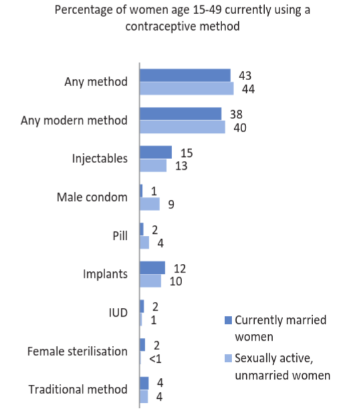
Uganda offers a range of family planning methods through government health facilities, private clinics, NGOs, and community health programs.
These include:
Availability can vary depending on location, supply chains, age, and access to health services.
While FlowReady’s primary focus is preparing girls for menstruation before their first period, we recognize that menstrual health exists within a broader reproductive health context. Accurate information and access to health services are important for helping young people make informed decisions throughout adolescence and adulthood.